台积电 TSMC 2026 Q2 财报电话会
一句话:AI 的结构性需求把台积电全年营收指引顶到"美元计增长略高于 40%"、全年 CapEx 上调到 600–640 亿美元,并宣布亚利桑那再加码 1000 亿美元;但本季净利同比 +77% 含一次性收益,需拆开看。
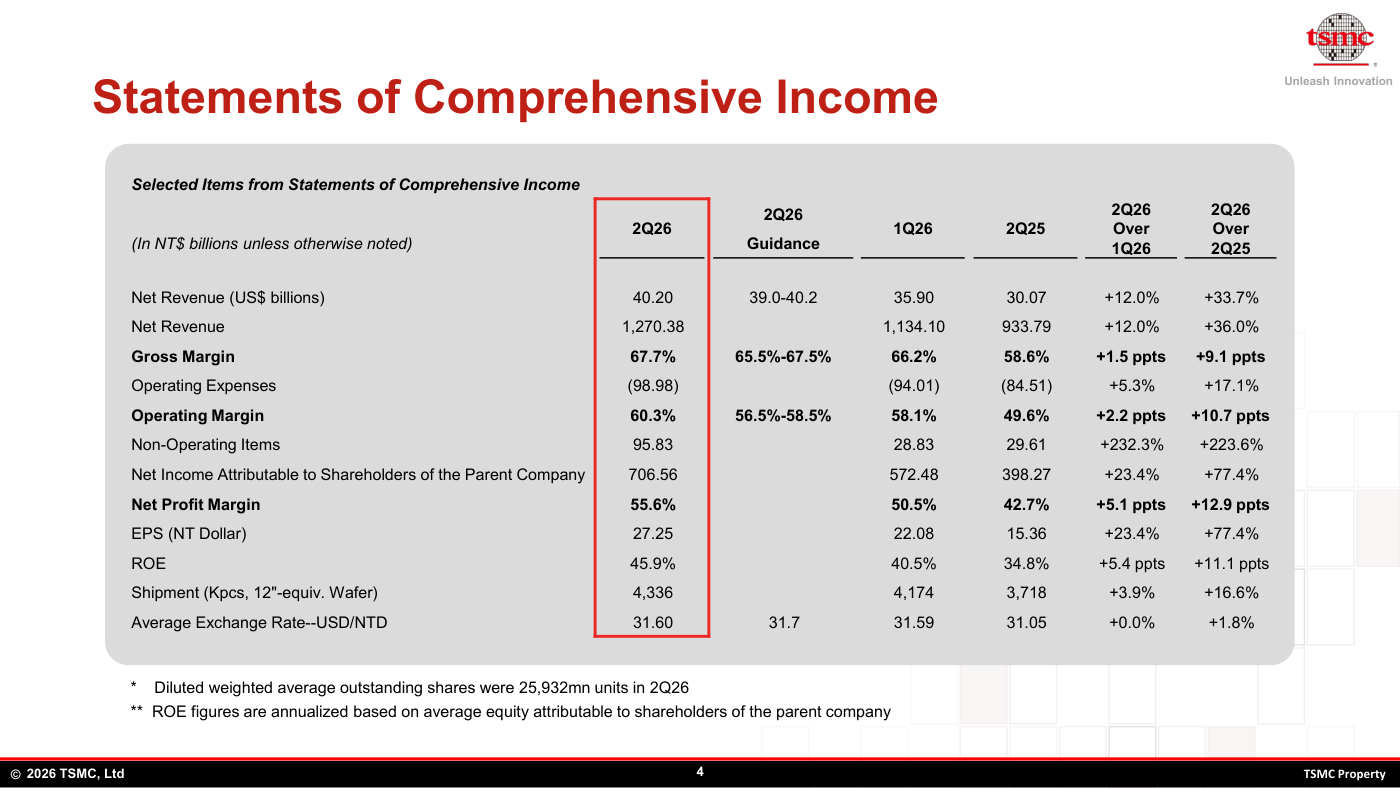
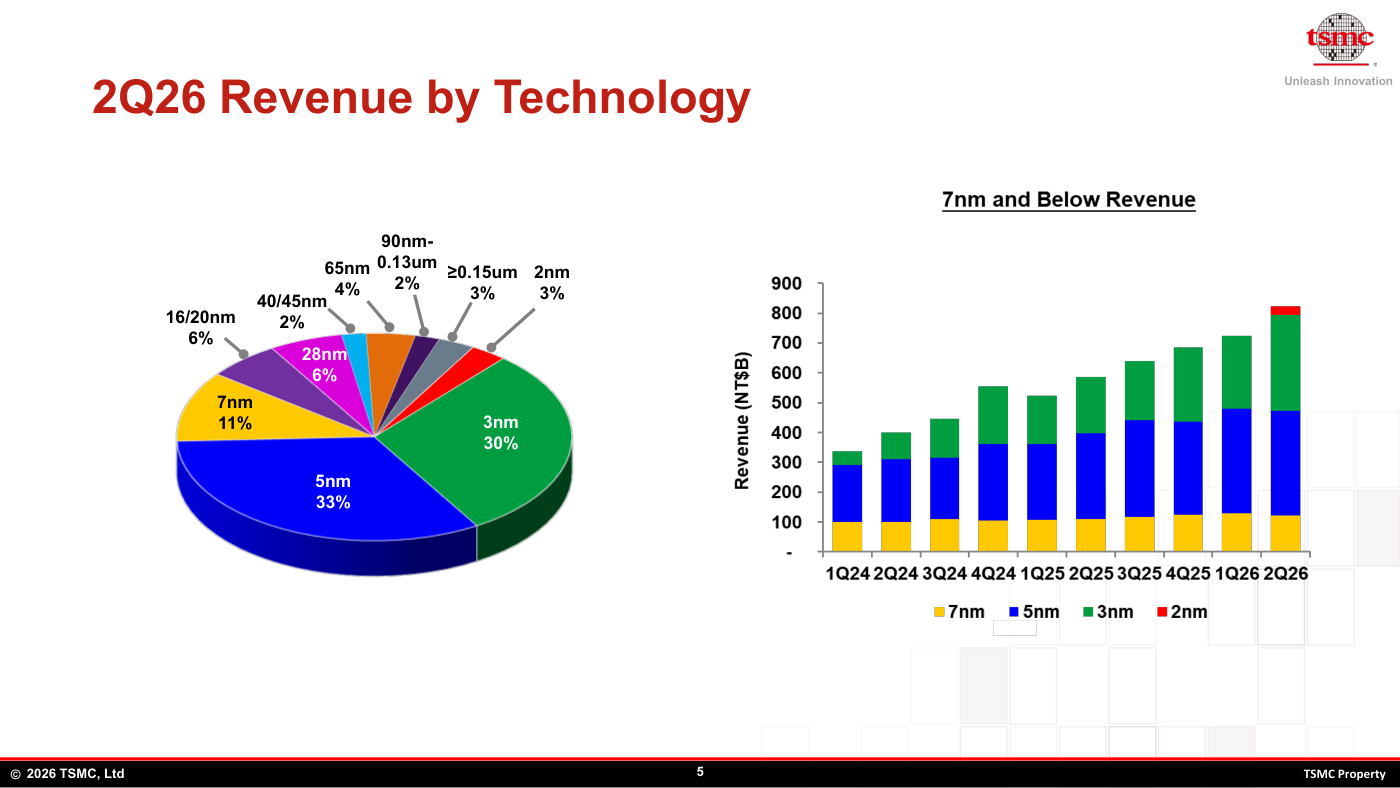
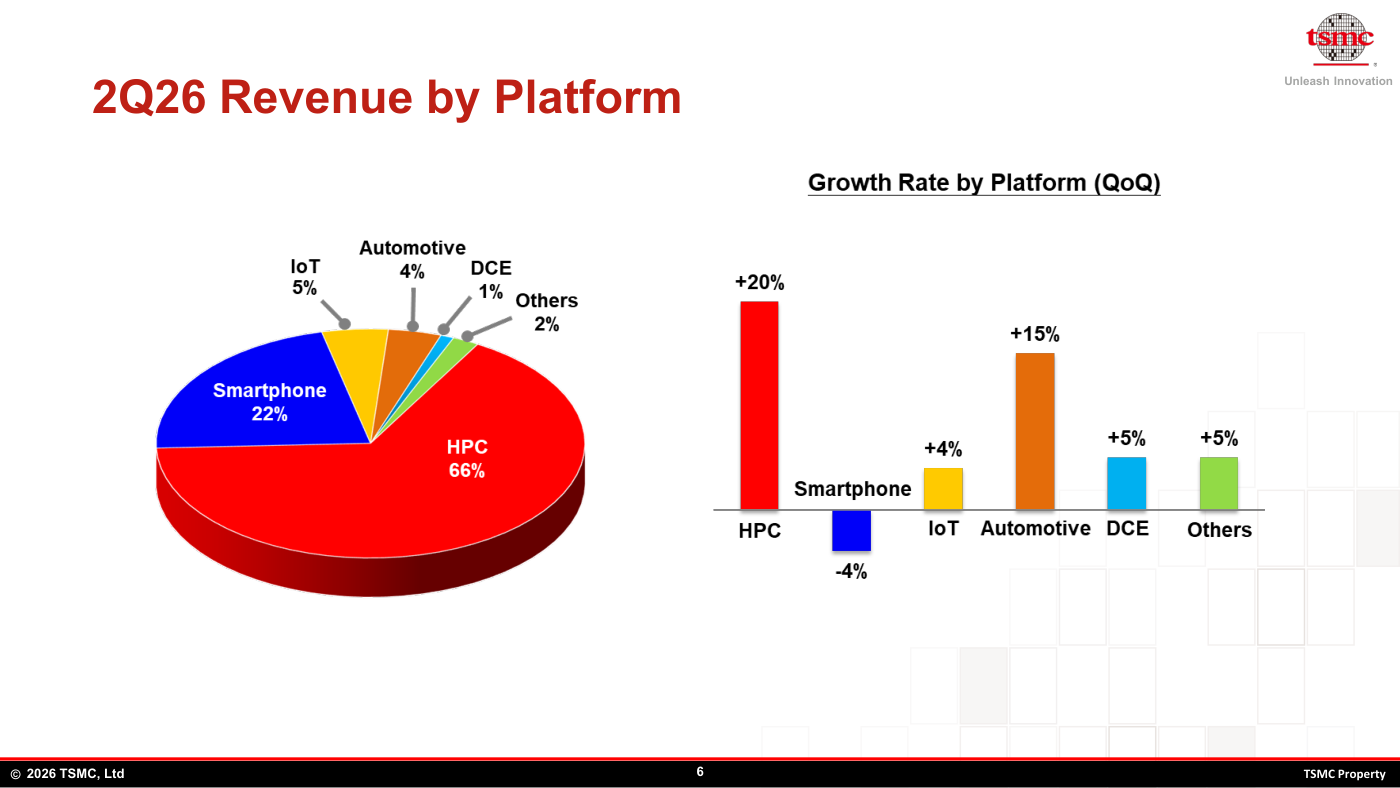
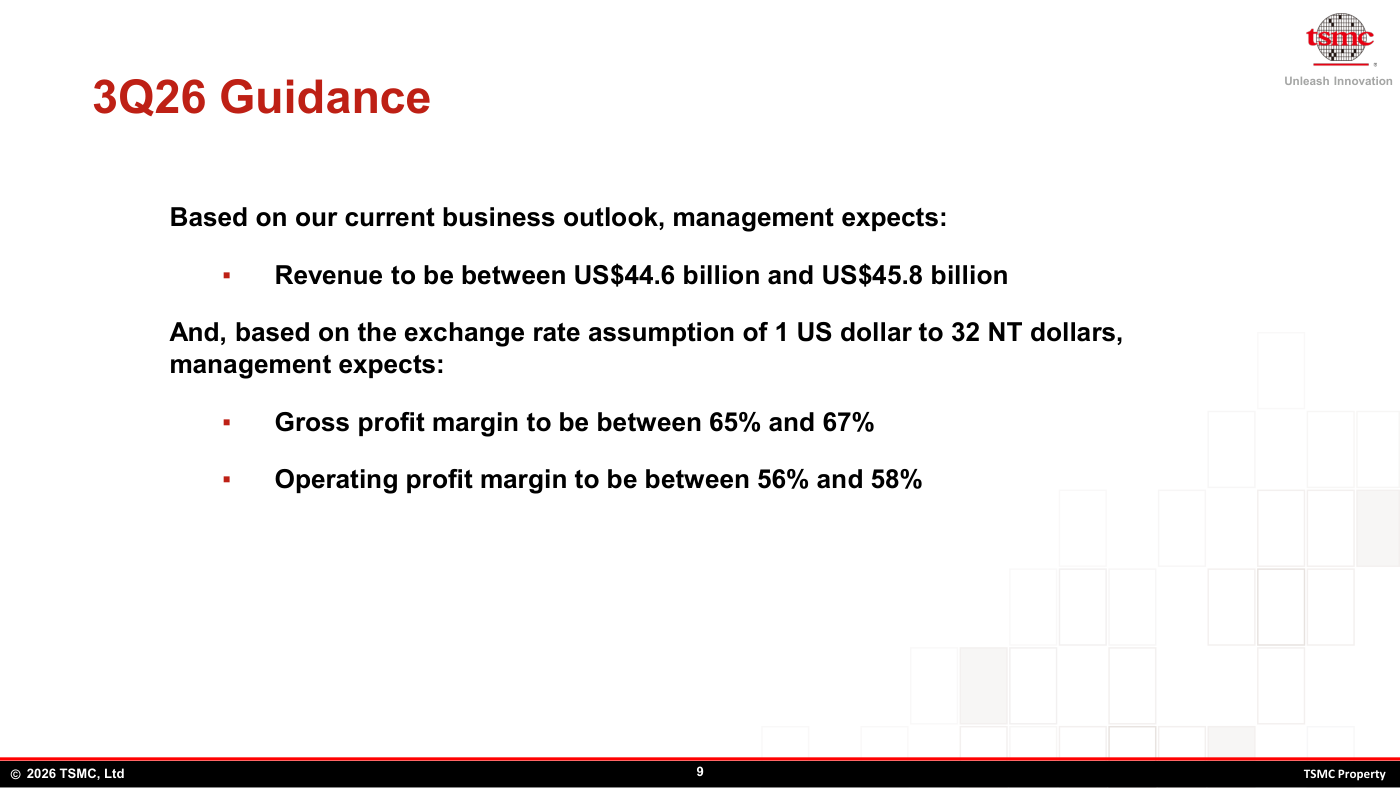
• 营收 US$40.20B(环比 +12%,同比 +33.7%),落在指引高端;台币营收同比 +36%。 • 毛利率 67.7%(环比 +1.5ppt,同比 +9.1ppt),略超指引:成本改善+稼动率提升,部分被海外厂稀释抵消。营业利润率 60.3%,净利率 55.6%。 • EPS NT$27.25(US$4.31/ADR),ROE 45.9%。注意:其中含出售世界先进(Vanguard)股权的一次性收益,贡献 EPS NT$2.24(约 8%),剔除后约 25.0。经营成色应看营收 +36%、毛利率同比 +9.1ppt 的扩张。 • 平台结构:HPC 占 66%(环比 +20%),首次占到营收三分之二,AI 是绝对主引擎;智能手机 22%(-4%)。 • 制程:2nm 首次上量占 3%,3nm 30%,5nm 33%,7nm 11%;先进制程(≤7nm)合计 77%。 • 3Q26 指引:营收 US$44.6–45.8B(环比 +12%、同比 +37% 中值);毛利率 65–67%(中值 66%,环比 -1.7ppt,主因 2nm 陡峭爬坡稀释约 3–4ppt)。
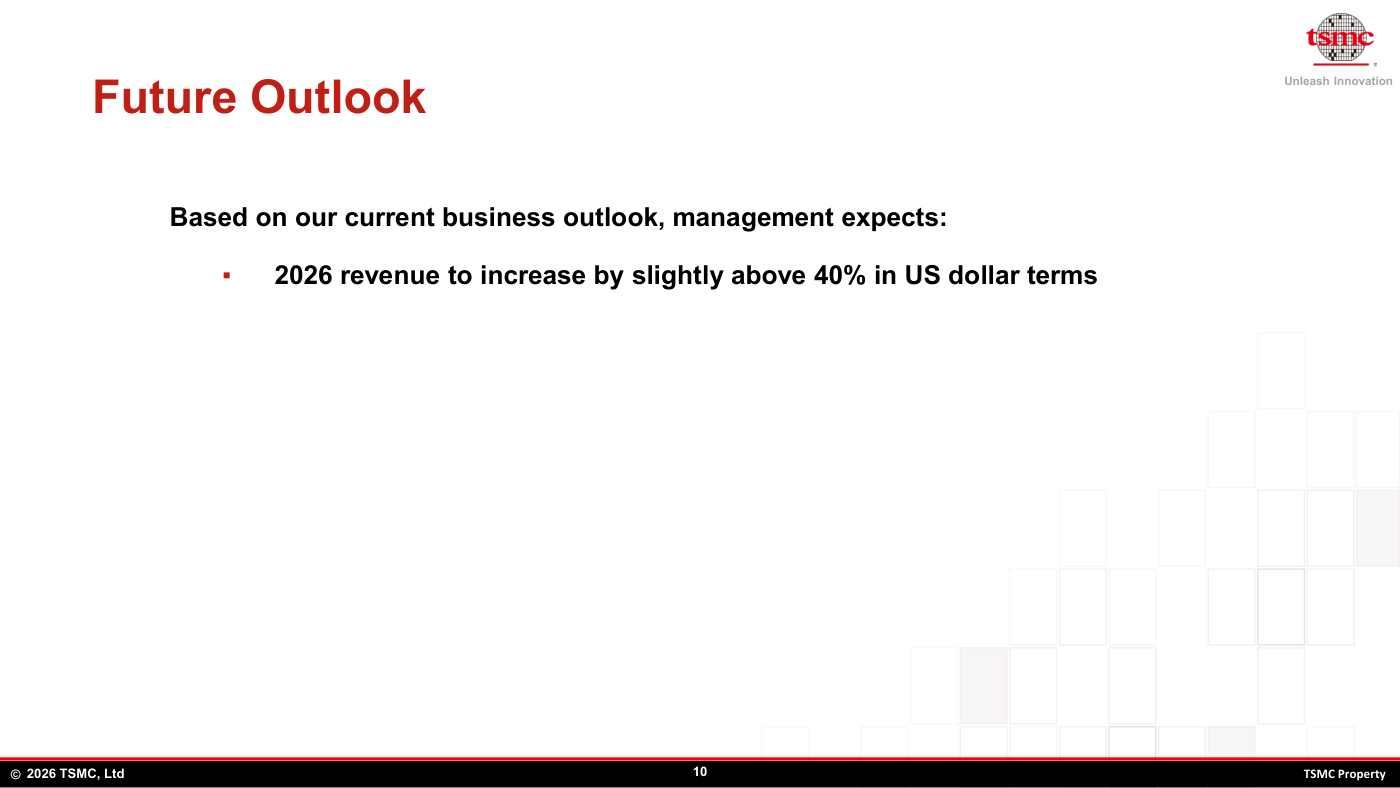
• 全年上调:2026 美元计营收增长"略高于 40%";全年 CapEx 上调至 US$60–64B(其中 70–80% 投先进制程,约 10% 特殊制程,10–20% 先进封装/测试/光罩),理由是含 agentic AI 的结构性需求。 • 重磅扩产:宣布亚利桑那额外投资 1000 亿美元(累计达 2650 亿),新建多座 2nm 及以下逻辑厂+先进封装厂;未来数年在台湾建 13 座先进制程与先进封装厂。 • agentic AI 新叙事:Agentic AI 带动 CPU 在 AI 数据中心复兴,x86/ARM/RISC-V 几乎都是台积电客户,被视为增量利好。 • 制程路线图:A14(较 N2 提速 10–15% 或省电 25–30%、密度+近 20%)2027 风险试产、2028 量产;衍生的 A13/A12 计划 2029 量产。 • 股东回报:2026 每股现金股息 NT$24(同比 +33%),承诺持续稳步提升。
(逐字稿为 LSEG StreetEvents 编辑版,来源 TSMC 官网 IR;仅供个人研究。)
| 指标 | 本季 | 环比 QoQ | 同比 YoY |
|---|---|---|---|
| 营收(US$) | 40.20B | +12.0% | +33.7% |
| 营收(NT$) | 1,270.38B | +12.0% | +36.0% |
| 毛利率 | 67.7% | +1.5ppt | +9.1ppt |
| 营业利润率 | 60.3% | +2.2ppt | +10.7ppt |
| 净利率 | 55.6% | — | — |
| 净利 | NT$706.56B | +23.4% | +77.4% |
| EPS | NT$27.25 / US$4.31 | +77.4% | |
| ROE | 45.9% |
- 3Q26 营收 US$44.6–45.8B(环比 +12%、同比 +37% 中值)
- 3Q26 毛利率 65–67%(中值 66%,环比 -1.7ppt,主因 2nm 陡峭爬坡稀释约 3–4ppt)
- 3Q26 营业利润率 56–58%(汇率假设 1 USD = 32 NTD)
- 全年 2026 营收:美元计增长「略高于 40%」(上调)
- 全年 CapEx 上调至 US$60–64B(约 70–80% 投先进制程)
- 扩产:亚利桑那再加码 1,000 亿美元(累计 2,650 亿);台湾未来数年新建 13 座厂
- 一次性提醒:净利/EPS 含出售世界先进(Vanguard)股权收益,贡献 EPS +NT$2.24(约 8%)
(Spoken in Foreign Language) Good afternoon, everyone, and welcome to TSMC's second-quarter 2026 earnings conference and conference call. This is Jeff Su, TSMC's Director of Investor Relations and your host for today. Today's event is being webcast live through TSMC's website at www. tsmc. com, where you can also download the earnings release materials. If you are joining us through the conference call, your dial-in lines are in listen-only mode. The format for today's event will be as follows.
First, TSMC's Senior Vice President and CFO, Mr. Wendell Huang, will summarize our operations in the second quarter 2026, followed by our guidance for the third quarter 2026. Afterwards, Mr. Huang and TSMC's Chairman and CEO, Dr. C.C. Wei, will jointly provide the company's key messages. Then we will open both the floor and the line for the question-and-answer session. As usual, I'd like to remind everybody that today's discussions may contain forward-looking statements that are subject to significant risks and uncertainties, which could cause actual results to differ maturity from those contained in the forward-looking statements.
Please refer to the Safe Harbor notice that appears in our press release. And now, I would like to turn the microphone over to TSMC CFO, Mr. Wendell Huang, for the summary of operations and the current quarter guidance.
(以非中文发言) 各位下午好,欢迎参加台积电2026年第二季度业绩说明会与电话会议。我是台积电投资人关系总监Jeff Su,也是今天的主持人。本次活动正通过台积电官网 www.tsmc.com 进行网络直播,您也可在该网站下载业绩发布资料。若您是通过电话会议加入,您的拨入线路处于只听模式。今天的议程如下:首先,台积电资深副总经理暨财务长黄仁昭先生将概述2026年第二季度的营运表现,接着说明我们对2026年第三季度的展望。随后,黄财务长将与台积电董事长暨执行长魏哲家博士共同提供公司的重要信息。之后,我们将开放现场及线上提问。依照惯例,我要提醒大家,今天的讨论可能包含前瞻性陈述,而这些陈述面临重大风险与不确定性,可能导致实际结果与前瞻性陈述内容存在重大差异。请参阅我们新闻稿中的安全港声明。现在,我将麦克风交给台积电财务长黄仁昭先生,请他进行营运摘要及本季度展望。
Thank you, Jeff. Good afternoon, everyone. Thank you for joining us today. My presentation will start with financial highlights for the second quarter of 2026. After that, I will provide the guidance for the third quarter of 2026. [Second quarter revenue increased 12.0 percent sequentially in NT dollars, supported by strong demand for our leading-edge process technologies. In US dollar terms, revenue also increased 12.0 percent sequentially to 40.2 billion, at the high-end of our second quarter guidance.
Gross margin increased by 1.5 percentage points sequentially to 67.7%, primarily due to cost improvement efforts and a higher capacity utilization rate, partially offset by margin dilution from overseas fabs]. [Total operating expenses accounted for 7.8% of net revenue, as compared to 8.3% in 1Q26, mainly due to operating leverage. Thus, operating margin increased by 2.2 percentage points sequentially to 60.3%. Total non-operating items were a gain of 96 billion NT dollars, an increase of 67 billion sequentially.
The increase was mainly due to disposal and mark-to-market gains of 63 billion on Vanguard shares, which contributed 2.24 NT dollars to second-quarter EPS. Overall, our second quarter EPS was 27.25 NT dollars, and ROE was 45.9%]. (added by company after the call) Now let's move on to revenue by technology. 2-nanometer process technology contributed3%of wafer revenue in the second quarter. 3-nanometer, 5-nanometer, and7-nanometer accounted for 30%, 33%, and 11%, respectively.
Advanced technology, defined as 7-nanometer and below, accounted for 77% of wafer revenue. Moving on to revenue contribution by platform. HPC increased 20% quarter over quarter to account for 66% of our second-quarter revenue. Smartphone decreased 4% to account for 22%. IoT increased 4% to account for 5%. Automotive increased 15% to account for 4%. DCE increased 5% to account for 1%. Moving on to the balance sheet, we ended the second quarter with cash and marketable securities of TWD3.5 trillion or USD110 billion.
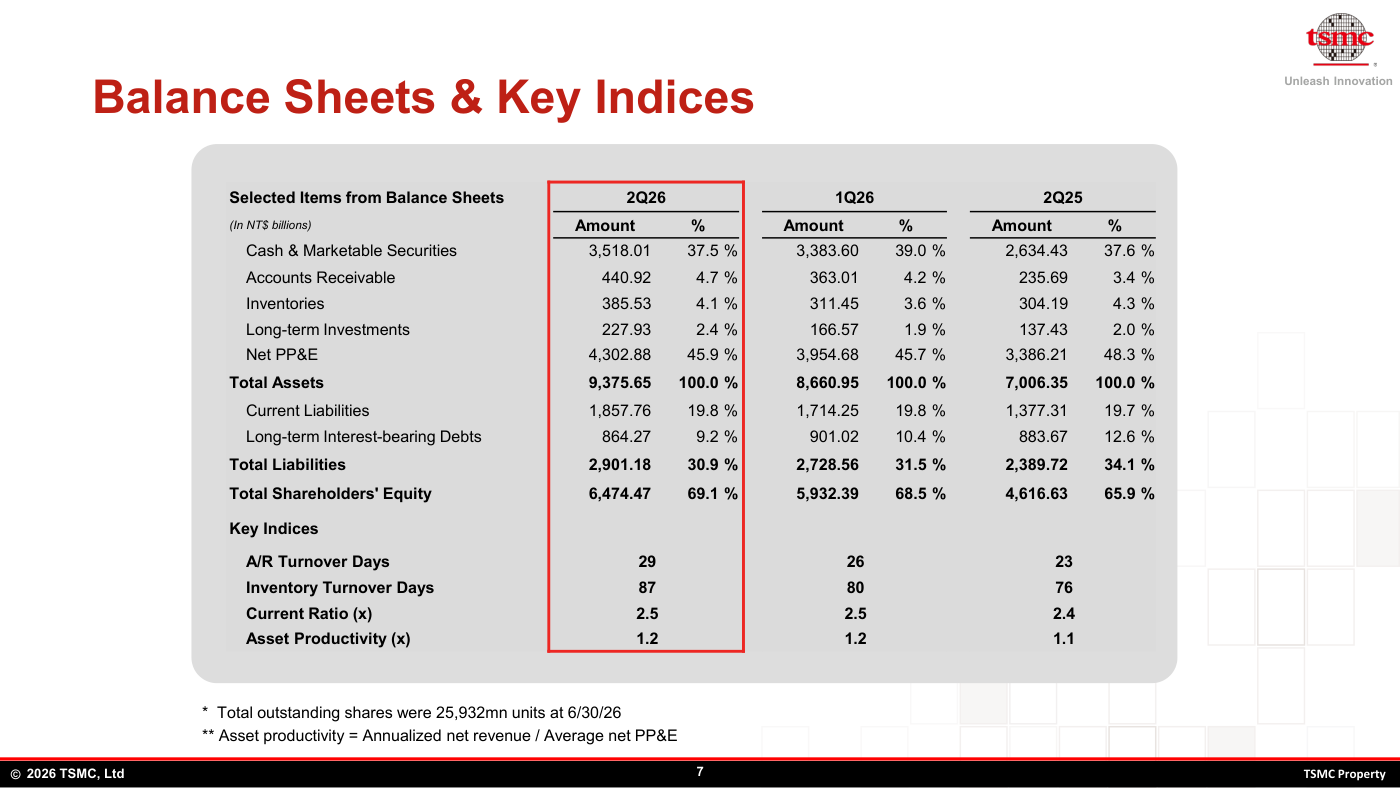
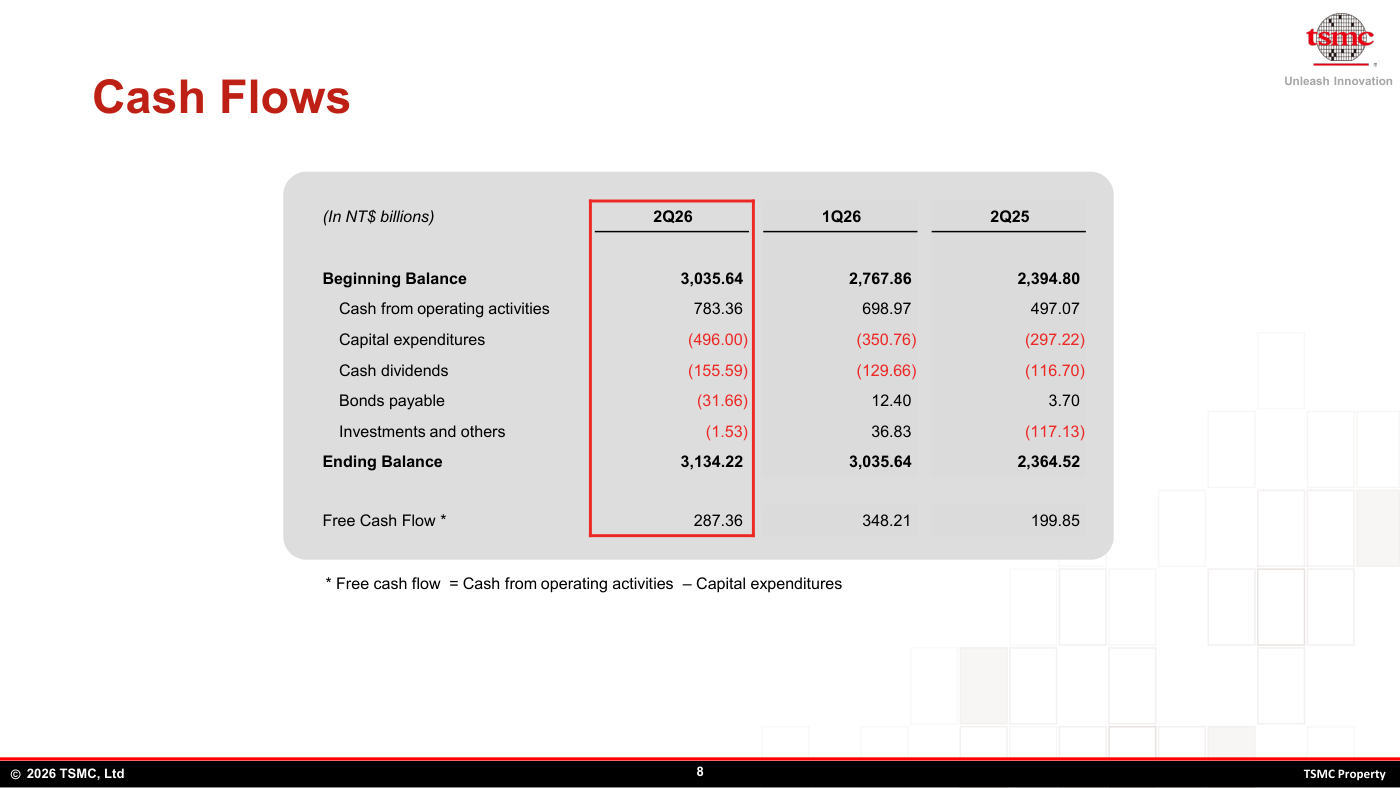
On the liability side, current liabilities increased by TWD144 billion quarter over quarter, mainly due to the increase of TWD58 billion in accounts payable and the increase of TWD48 billion in accrued liabilities and others. In terms of financial ratios, accounts receivable days increased by 3 days to 29 days. Inventory days increased 7 days to 87 days, primarily due to the ramp of N2 technology. Regarding cash flow and CapEx. During the second quarter, we generated about TWD783 billion in cash from operations, spent TWD496 billion in CapEx, and distributed TWD156 billion for third quarter 2025 cash dividend.
Overall, our cash balance increased TWD99 billion to TWD3.1 trillion at the end of the quarter. In US dollar terms, our second quarter capital expenditures totaled USD15.7 billion. I finished my financial summary. Now let's turn to the current quarter guidance. Based on the current business outlook, we expect our third-quarter revenue to be between USD44.6 billion and USD45.8 billion, which represents a12%sequential increase or a37%year-over-year increase at the midpoint.
Based on the exchange rate assumption of USD1 to TWD32, gross margin is expected to be between 65% and 67%, operating margin between 56% and 58%. This concludes my financial presentation. Now let me turn to our key messages. I will start by talking about our second-quarter '26 and third-quarter '26 profitability. Compared to the first quarter, our second quarter gross margin increased by 150 basis points sequentially to 67.7%, slightly ahead of our guidance, primarily due to cost improvement efforts and a slightly higher overall capacity utilization rate, partially offset by dilution from our overseas fabs.
We have just guided our third quarter gross margin to decrease by 1.7 percentage point to 66% at the midpoint, primarily as we expect the steep ramp-up of our 2-nanometer technology to dilute our gross margin by about 3 to 4 percentage points. This dilution is expected to be partially offset by very strong demand for our leading-edge technologies and continued cost improvement efforts, including productivity gains and across-node capacity optimization. Looking at the second-half of the year, given the six factors that determine our profitability, there are a few puts and takes that I would like to share.
First, we expect a steep ramp-up of our 2-nanometer to dilute our gross margin by about 3 to 4 percentage points in the second half of the year. Furthermore, as the scale of our overseas expansion grows, we continue to forecast the gross margin dilution from the ramp-up of overseas fabs in the next several years to be 2% to 3% in the early stages and widen to 3% to 4% in the latter stages. On the other hand, demand for our leading-edge technologies is very strong. In addition, we continue to leverage our manufacturing excellence to generate more wafer output and drive greater across-node capacity optimization in our fab operations to support our profitability.
Finally, we have no control over the foreign exchange rate, but that may be another factor. Next, let me talk about our 2026 capital budget. At TSMC, a higher level of capital expenditures is always correlated to higher growth opportunities in following years. With our strong technology leadership and differentiation, we are well positioned to capture the multi-year structural demand from the industry megatrends of 5G, AI, and HPC. Given the continued strong structural demand from our customers, including the newly emerging agentic AI market, we have decided to raise our full-year 2026 capital budget to be between USD60 billion and USD64 billion as we continue to invest heavily to support our customers' growth.
We always collaborate closely with the tool suppliers well in advance to prepare the capacity, whether it is a strong upcycle or downcycle, just like our customers collaborate with us well in advance to plan our capacity. Thus, we do not foresee any bottlenecks to our capacity expansion plans. About 70% to 80% of the 2026 capital budget will be allocated for advanced process technologies, about 10% will be spent for specialty technologies, and about 10% to 20% will be spent for advanced packaging, testing, mask making and others.
Even as we invest for the future growth with this level of CapEx spending in 2026, we remain committed to delivering profitable growth to our shareholders. We also remain committed to a sustainable and steadily increasing cash dividend per share on both an annual and quarterly basis. In 2025, we paid TWD467 billion in cash dividends, up 28.6% year over year as TSMC shareholders receive a total of TWD18 cash dividend per share. In 2026, they will receive TWD24 per share, up another 33% year over year, and we expect a continued and increasing cash dividends per share in 2027 as well.
Now let me turn the microphone over to C.C.
谢谢你,Jeff。各位下午好,感谢大家今天参与。我的报告将从2026年第二季的财务亮点开始。之后,我将提供2026年第三季的财务指引。第二季以新台币计营收环比成长12.0%,受益于对我们先进制程技术的强劲需求。以美元计,营收同样环比成长12.0%,达到40.2 billion,落于我们第二季指引的区间上缘。毛利率环比增加1.5个百分点至67.7%,主要由于成本改善的努力和较高的产能利用率,但这部分被海外晶圆厂带来的毛利率稀释所抵消。总营业费用占净营收的7.8%,相比之下2026年第一季为8.3%,主要由于营业杠杆。因此,营业利润率环比增加2.2个百分点至60.3%。非营业项目合计为收益960亿新台币,环比增加670亿。增加主要来自处分及按市值重估世界先进持股所产生的630亿收益,这对第二季每股盈余贡献了2.24元新台币。整体而言,我们第二季每股盈余为27.25元新台币,股东权益报酬率为45.9%。现在让我们看按技术划分的营收。2纳米制程技术在第二季贡献了晶圆营收的3%。3纳米、5纳米和7纳米分别占30%、33%和11%。先进制程,即7纳米及以下,占晶圆营收的77%。
接着看各平台的营收贡献。HPC营收环比成长20%,占第二季营收的66%。智能手机营收减少4%,占22%。IoT营收成长4%,占5%。车用电子营收成长15%,占4%。DCE营收成长5%,占1%。接着看资产负债表,我们第二季结束时拥有现金与有价证券3.5万亿新台币,或1100亿美元。在负债方面,流动负债环比增加1440亿新台币,主要由于应付账款增加580亿,以及应计负债与其他增加480亿。在财务比率方面,应收账款周转天数增加3天至29天。存货周转天数增加7天至87天,主要由于N2技术的放量。关于现金流与资本支出。第二季,我们产生了约7830亿新台币的营业现金流入,支出了4960亿新台币的资本支出,并配发了1560亿新台币的2025年第三季现金股利。整体而言,我们的现金余额在季末增加了990亿新台币至3.1万亿新台币。以美元计,我们第二季的资本支出总额为15.7 billion。我的财务摘要到此结束。现在来看本季的指引。基于目前的业务展望,我们预期第三季营收将介于USD44.6 billion和USD45.8 billion之间,以中点计代表环比成长12%或同比成长37%。
基于1美元兑32新台币的汇率假设,毛利率预期将介于65%和67%之间,营业利润率介于56%和58%之间。我的财务报告到此结束。接下来请让我转向我们的关键信息。我将先谈2026年第二季及第三季的获利能力。相较于第一季,我们第二季的毛利率环比增加150个基点至67.7%,略微领先我们的指引,主要由于成本改善的努力和整体产能利用率略为提升,但这部分被来自海外晶圆厂的稀释所抵消。我们方才提供的第三季毛利率指引,中位数下降1.7个百分点至66%,主要因为我们预期2纳米技术的急剧爬坡将稀释我们的毛利率约3到4个百分点。这种稀释效应预期将被先进制程技术的非常强劲需求,以及持续的成本改善努力(包括生产力提升和跨节点产能优化)部分抵消。展望下半年,考虑到决定我们获利能力的六项因素,我想分享一些增减变化。首先,我们预期2纳米的急剧爬坡将在下半年稀释毛利率约3到4个百分点。此外,随着海外扩张的规模增长,我们持续预测未来数年来自海外晶圆厂爬坡的毛利率稀释,在初期阶段约为2%至3%,并在后期阶段扩大至3%至4%。另一方面,对我们先进制程技术的需求非常强劲。
此外,我们持续运用卓越制造能力,以产生更多的晶圆产出,并在晶圆厂运营中推动更大的跨节点产能优化,以支撑我们的获利能力。最后,外汇汇率我们无法控制,但这可能是另一个因素。接下来,让我谈谈我们的2026年资本预算。在台积电,较高水平的资本支出总是与未来年份更高的成长机会相关联。凭借我们强大的技术领导力与差异化,我们已做好准备,捕捉来自5G、AI与HPC等产业大趋势的多年结构性需求。鉴于来自客户持续强劲的结构性需求,包括新兴的代理式AI市场,我们决定将2026年全年资本预算提高至介于USD60 billion和USD64 billion之间,因为我们继续大力投资以支持客户的成长。我们始终提前与设备供应商密切合作以准备产能,无论是强劲的上升周期还是下降周期,就如同我们的客户提前与我们密切合作以规划他们的产能一样。因此,我们不预见产能扩张计划会遇到任何瓶颈。2026年资本预算中约70%至80%将分配给先进制程技术,约10%用于特殊制程技术,约10%至20%用于先进封装、测试、光罩制作及其他。即便我们在2026年以此水平的资本支出为未来成长进行投资,我们仍然致力于为股东带来具获利性的成长。
我们也仍然致力于以可持续且稳定增加的方式,按年与按季提供每股现金股利。2025年我们支付了4670亿新台币的现金股利,年增28.6%,台积电股东合计收到每股18元新台币的现金股利。2026年他们将收到每股24元新台币,再年增33%,我们预期2027年每股现金股利也将会持续增加。现在让我把麦克风交给C.C.。
Thank you, Wendell. Good afternoon, everyone. First, let me start with our near-term demand outlook. We concluded our second quarter with revenue of USD40.2 billion, at the high end of our guidance in US dollar terms, driven by strong demand for our leading-edge process technologies. Moving into third quarter, we expect our business to be supported by continuous strong demand for our leading-edge process technologies, including the steep ramp up of our 2-nanometer technology.
Looking ahead, we observe consumer and the price-sensitive end-market segment are being challenged due to the impact of rising component prices and macroeconomics uncertainties. As such, we are being prudent in our business planning while focusing on our fundamentals of our business to further strengthen our competitive position. Having said that, AI-related demand continues to be extremely robust. The AI megatrend continues to drive the need for more and more computation, which supports the robust demand for leading-edge silicon.
Our customers and customers' customers, who are mainly the cloud service provider, continue to provide us with their very strong signal and positive outlook. Thus, our conviction in the multi-year AI megatrend remain very high. Supported by our robust technology differentiation and the broad customer base, we now expect our full-year 2026 revenue growth to be slightly above 40% year over year in US dollar terms. Now let me talk about the acceleration of agentic AI. The AI market continues to be very dynamic.
The emergence of agentic AI is leading to a resurgence in the role of CPUs in AI data centers, which drives more silicon demand in addition to AI accelerators. We believe this is positive for TSMC, as no matter what CPU approach is taken, whether it's x86, ARM-based, or RISC-V architecture, they are almost all TSMC's customers. We are already collaborating closely with our CPU customers and working to support them with the most advanced technologies and necessary capacity, so they can capture agentic AI market opportunities.
Next, let me talk about TSMC's capacity expansion strategies. To address the structural increase in overall long-term semiconductor market demand profile, TSMC collaborates closely with our customers and our customers' customers to plan our capacity. Given the fundamental complexity of leading-edge technologies and the design-in and lead time involved, we also have a very good idea of their multi-year product roadmap and production plans. This is important because it takes more than five years to develop the technology and product, prepare the capacity, and ramp it up to high-volume production.
Internally, TSMC employs a disciplined capacity planning system to assess the market demand from both a top-down and bottom-up approach. This is a continuous and ongoing process. Based on our assessment, we are stepping up our CapEx investment to increase our capacity to support our customers' future growth. Now, with a strong collaboration and support from our leading US customers and the US federal, state, and city governments, we would like to announce an additional USD100 billion investment in Arizona.
This is to build several more semiconductor logic wafer fabs for 2-nanometer and below technologies, as well as advanced packaging fabs, to support strong multi-year demand from our leading US Customers. We believe this investment will help to further foster the development of the US semiconductor ecosystem, strengthen the supply chain, and support an increasing number of high-tech, high-paying jobs in the United States. At the same time, we are building 13 leading-edge and advanced packaging fabs in Taiwan over the next several years, and we will continue to further invest in Taiwan.
Therefore, TSMC's semiconductor technology and manufacturing will continue to play a pivotal role in supporting the global semiconductor industry, while unleashing our customers' innovation. Now let me talk about the current N3 capacity expansion. We are executing well on our global plan to add three additional 3-nanometer fabs, one in Taiwan, one in Arizona, and one in Japan, to support the robust multi-year pipeline of demand for 3-nanometer technologies. In addition to all the new fabs, we continue to convert 5-nanometer tools to support 3-nanometer capacity in Taiwan.
We are also leveraging our manufacturing excellence to drive greater productivity across our fab in all locations to generate more wafer output. We are also focusing on capacity optimization across nodes, which includes flexible capacity support among N7, N5, and N3 nodes. In summary, we are using multiple levers to do everything we can, wherever we can, however we can, to maximize the support to all our customers. Now, let me talk about our mature node strategies. TSMC's strategy at mature node has not changed.
Our first priority is to fully support our customers, and now we continue to increase, not decrease, our mature node capacity in the higher value-added segment. For example, we are increasing our mature node capacity through JASM Fab 1 in Japan, for CMOS Image Sensor application, and ESMC in Germany for automotive and industrial applications. In today's market, outside of specific areas such as power management IC and CMOS image sensor, the mature node demand in other commodity areas is not that strong.
Thus, TSMC will continue to focus on the higher value-added and strategic segments, while ensuring we have the necessary capacity to support our customers' growth. Finally, let me talk about our A14 status. As I mentioned a few minutes ago, the complexity of leading-edge technology continues to increase. The lead time to develop a new technology such as A14, building the capacity, and then ramp it up now takes five to seven years. There are no shortcuts. Our A14 technology represents the second generation of nanosheet transistors and delivers another full-node stride from N2, with performance and power benefits to address the insensible need for high-performance and energy-efficient computing.
Compared with N2, A14 will provide a 10 to 15% speed improvement at the same power or 25 to 30% power improvement at the same speed, and close to 20% chip density gain. A14 technology development is on track and progressing well. Internal product-like vehicle demonstrated close to 90% device performance and close to 90% 256 megabits SRAM yield. We are observing a strong level of customer interest and engagement on both smartphone and HPC/AI applications, and customer new tap-out activity is ongoing and ahead of schedule.
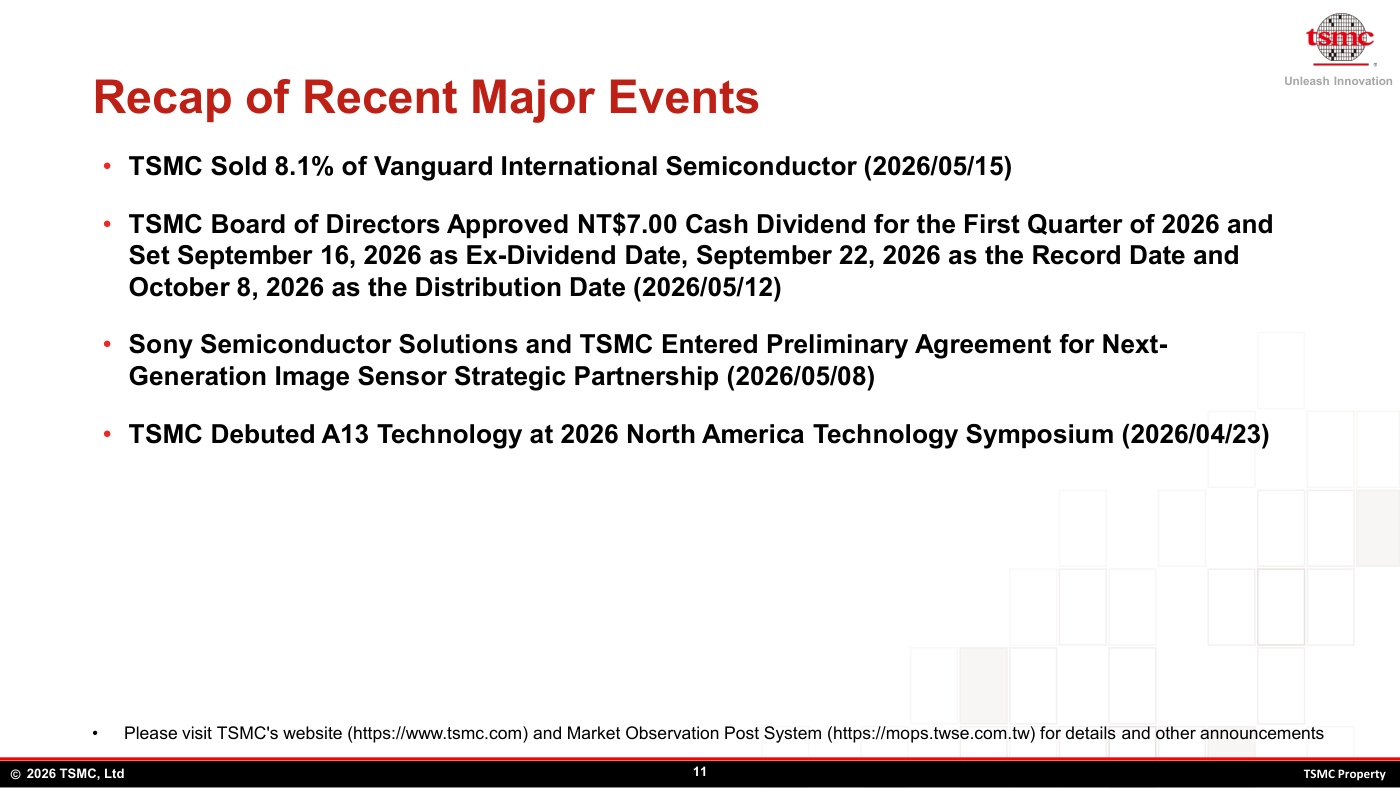
Risk production will start in2027and volume production is scheduled for2028.With our strategy of continuous enhancement, we also introduced A13 and A12 as extension of the A14 family. A13 represents a further advancement of our A14, achieving an over 6% die area saving through an innovative 97% optical shrink. Through continuous design-technology co-optimization,A13also delivers further performance and power efficiency improvement.A13design rules are backward compatible with A14 to ensure smooth IP migration.
We also introduced A12, which will bring our innovative Super Power Rail technology to the A14 platform for superior performance, power, and area benefits. Both A13 and A12 are scheduled for volume production in 2029. We believe A14 and its derivative technologies will propel our A14 firmly to be an even larger and long-lasting node for TSMC than N2, just like a 2-nanometer technology is a larger and longer-lasting node than 3-nanometer, and help further extend our technology leadership position well into the future.
This concludes our key messages, and thank you for your attention.
谢谢你,Wendell。各位下午好。首先,让我从近期的需求展望开始。我们第二季度营收为 USD40.2 billion,落在我们以美元计价的指引区间上缘,主要受惠于对我们先进制程技术的强劲需求。进入第三季度,我们预期业务将继续受到先进制程技术持续强劲需求的支撑,其中包括 2 纳米技术的快速爬坡。展望未来,我们观察到消费性及价格敏感型终端市场,正因零部件成本上升与总体经济不确定性而面临挑战。因此,我们在业务规划上保持审慎,同时专注于业务基本面,以进一步加强我们的竞争优势。尽管如此,AI 相关需求仍极为强劲。AI 大趋势持续驱动更多算力需求,进而支撑对先进制程芯片的强劲需求。我们的客户以及客户的客户,主要是云端服务供应商,持续给我们非常强烈的讯号和正向展望。因此,我们对为期多年的 AI 大趋势仍然保持高度确信。在我们强劲的技术差异化与广泛客户基础的支持下,我们现在预期 2026 年全年营收以美元计算将年增略高于 40%。 现在让我谈谈 agentic AI 的加速发展。AI 市场依然非常活跃。agentic AI 的出现正引导 CPU 在 AI 数据中心中角色的复苏,这在 AI 加速器之外,驱动了更多的芯片需求。
我们相信这对台积电是正面的,因为无论采用哪种 CPU 方案,无论是 x86、基于 ARM 或 RISC-V 架构,它们几乎都是台积电的客户。我们已与 CPU 客户展开密切合作,致力于以最先进的技术和所需的产能支持他们,使其得以抓住 agentic AI 的市场机遇。 接下来,让我谈谈台积电的产能扩张策略。为应对整体长期半导体市场需求的结构性增长,台积电与我们的客户及客户的客户密切合作,共同规划产能。鉴于先进制程技术的根本复杂性,以及所涉及的设计导入与前置时间,我们对他们多年的产品蓝图和生产计划也有很清楚的掌握。这一点至关重要,因为开发展技术和产品、准备产能并爬坡至量产需要超过五年的时间。在内部,台积电采用一套严谨的产能规划系统,结合自上而下与自下而上的方法来评估市场需求。这是一个持续进行的过程。根据我们的评估,我们正在提高资本支出,以增加产能来支持客户未来的增长。 现在,在我们主要的美国客户以及美国联邦、州和市政府的大力合作与支持下,我们在此宣布将在亚利桑那州追加 USD100 billion 的投资。这将用于兴建数座更多座 2 纳米及以下技术的半导体逻辑晶圆厂,以及先进封装厂,以支持我们主要美国客户多年强劲的需求。
我们相信这项投资将有助于进一步促进美国半导体生态系统的发展,强化供应链,并在美国支持更多高科技、高薪资的工作岗位。同时,我们将在未来几年内,于台湾兴建 13 座先进制程与先进封装厂,并且我们将持续在台湾进一步投资。因此,台积电的半导体技术与制造将持续扮演关键角色,在释放客户创新的同时,支持全球半导体产业。 现在让我谈谈目前的 N3 产能扩张。我们在全球增加三座 3 纳米晶圆厂的计划执行顺利,这三座厂分别位于台湾、亚利桑那和日本,以支持多年来对 3 纳米技术强劲的需求管线。在这所有新晶圆厂之外,我们也持续在台湾转换 5 纳米机台,以支持 3 纳米产能。我们同时利用我们卓越的制造能力,推动所有地点晶圆厂的生产力提升,以产出更多晶圆。我们也专注于跨制程节点的产能优化,这包括在 N7、N5 和 N3 节点间提供灵活的产能支持。总而言之,我们正运用多重手段,尽我们所能、无论何处、不论何种方式,来最大化对所有客户的支持。 现在,让我谈谈我们的成熟制程策略。台积电在成熟制程的策略没有改变。我们最优先的目标是全力支持客户,而现在我们在较高附加价值领域,持续增加而非减少成熟制程产能。
例如,我们正通过位于日本 JASM 的第一座晶圆厂增加用于 CMOS Image Sensor 应用的成熟制程产能,并通过德国的 ESMC 增加用于车用与工业应用的产能。在今天的市场中,除了电源管理 IC 和 CMOS image sensor 等特定领域外,其他大众化产品领域的成熟制程需求并不那么强劲。因此,台积电将持续专注于较高附加价值与具战略性的领域,同时确保我们有必要的产能支持客户增长。 最后,让我谈谈我们的 A14 进度。正如我几分钟前所说,先进制程技术的复杂性持续增加。开发展像 A14 这样的新技术、建立产能并爬坡到量产,现在需要五到七年的时间。这没有捷径。我们的 A14 技术代表了第二代 nanosheet 晶体管,从 N2 技术推进了整整一个技术世代的跨越,以性能和功耗优势,满足对高效能且高能效计算无止境的需求。与 N2 相比,A14 在相同功耗下速度提升 10 到 15%,或在相同速度下功耗降低 25 到 30%,并达到接近 20% 的芯片密度增益。A14 技术开发正依计划顺利进行。类产品测试载具展现了接近 90% 的器件效能,以及接近 90% 的 256 megabits SRAM 良率。
我们观察到来自智能手机和 HPC/AI 应用的客户兴趣与投入程度相当强烈,客户新产品的流片活动持续进行且进度超前。风险生产将于 2027 年开始,量产则排定在 2028 年。凭借我们持续强化的策略,我们也推出 A13 和 A12 作为 A14 平台的延伸。A13 代表 A14 的进一步进阶,通过创新的 97% 光学微缩实现超过 6% 的芯片面积节省。通过持续的设计技术协同优化,A13 也提供了效能和功耗效率的进一步改善。A13 的设计规则向下兼容 A14,以确保 IP 的顺利转移。我们还推出了 A12,它将我们创新的 Super Power Rail 技术导入 A14 平台,以实现更优越的性能、功耗和面积表现。A13 和 A12 均排定于 2029 年量产。我们相信 A14 及其衍生技术,将稳固地推动 A14 成为台积电比 N2 规模更大、周期更长的制程节点,就像 2 纳米技术是比 3 纳米规模更大、周期更长的节点一样,并有助于将我们的技术领先地位进一步延伸至未来。以上是我们的重点信息摘要,感谢各位的聆听。
—— 问答环节 Q&A ——
—— 问答环节 Q&A ——
Thank you, C.C. So this does conclude our prepared statements. (Event Instructions) Sunny Lin, UBS.
谢谢 C.C.。以上是我们的预备发言内容。(活动说明)有请瑞银的 Sunny Lin。
Congrats on the very strong performance and outlook. So number one, I'll do a double-click on the CapEx. So very encouraging CapEx outlook, and I do think it's essential that TSMC showcase a stronger determination in capacity expansion, given the stronger demand and the very tight supply. And so beyond 2026, I think every large client also wonder how aggressive TSMC is planning for CapEx. And so back in the COVID super cycle, TSMC did provide a three-year CapEx outlook by then. And so I wonder at this point, would it be possible for you to share any color, maybe for the coming three years CapEx? Thank you.
恭喜取得非常强劲的业绩和展望。首先,我想深入问一下资本支出。资本支出展望非常令人鼓舞,考虑到需求走强且供应非常紧张,我认为台积电在产能扩张上展示出更强决心至关重要。而在 2026 年之后,我想每个大客户也都在关注台积电对于资本支出的规划有多积极。回顾新冠疫情期间的超级周期,当时台积电确实给出过三年期的资本支出展望。所以我想知道,在当前这个时点,您是否有可能就未来三年的资本支出分享一些信息?谢谢。
Okay. So Sunny's first question is regarding CapEx. She does believe it's important/essential to show our determination to support our customers with these large CapEx investments. So she wants to know, do we have a three-year CapEx guidance, '26, '27, '28, similar to what we did back in 2021?
好的。Sunny 的第一个问题是关于资本支出。她确实认为,展示我们通过大规模资本支出投资来支持客户的决心非常重要/关键。所以她想知道,我们是否有类似于 2021 年时做法那样的,针对 '26、'27、'28 年的三年期资本支出指引?
Hey, Sunny, we do not have a number to share with you. Butasyouknow, weinvest CapEx this year for the future business opportunity and as long as there are business opportunities, we will not hesitate to invest. As you can hear from our prepared remarks that our conviction in the megatrend, AI megatrend multi-year is very strong, and we are stepping up the CapEx, including increasing this year's CapEx. Last time, we said our CapEx in the next three years will be significantly higher than the CapEx in the past three years. Now the CapEx in the next three years will be even more significantly higher than the past three years.
Sunny,我们目前没有具体数字可以和你分享。但如你所知,我们今年的资本支出是为未来的业务机会而投资,只要有业务机会,我们就会毫不犹豫地投入。你从我们的预备发言中也能听出来,我们对大趋势、对 AI 这个多年大趋势的信念非常坚定,我们正在加大资本支出,包括提高今年的资本支出。上次我们说过,未来三年的资本支出将显著高于过去三年的资本支出。现在,未来三年的资本支出将比过去三年还要显著得多。
Yeah, maybe let me follow-up on CapEx from another -- yeah, sure. So you just announced additional USD100 billion CapEx in the US, and I think that's pretty important for you to secure the business in the US as well. And so now with total USD265 billion CapEx in Arizona, what's your current plan to bring on the capacities in Arizona in the coming few years?
好的,或许让我从另一个角度跟进一下资本支出的问题——好的。你们刚刚宣布了在美国追加 USD100 billion 的资本支出,我认为这对于你们争取美国业务也相当重要。那么,目前在亚利桑那州的投资总额达到 USD165 billion,你们未来几年在亚利桑那州产能上线的当前计划是怎样的?
Okay, so Sunny's second question is on to C.C. said investing an additional USD100 billion in Arizona based on the strong demand from our customers. So the total investment now isUSD265billion. What is the schedule, timeframe, or the plan for these investment? Is that correct, Sunny?
好的,Sunny 的第二个问题是关于 C.C. 提及的,基于客户的强劲需求,在亚利桑那州追加投资 USD100 billion。所以目前的总投资额是 USD165 billion。这些投资的时间表、时间框架或计划是怎样的?是这样吗,Sunny?
Sunny, the schedule will depend on the market situation, you know that. So today's situation. The makeup trend is so strong so that we announce additional USD100 billion investment in Arizona. How many fabs? Many. So actually, let me say that there's probably additional four or more fabs will be built.
Sunny,你知道的,时间安排将取决于市场状况。就今天的情况来看,AI 大趋势非常强劲,因此我们宣布了在亚利桑那州追加 USD100 billion 的投资。会建多少座晶圆厂?很多。实际上,可以说,很可能还会再增建四座或更多晶圆厂。
And that's combining frontend backend.
而且那将结合前段和后段。
Yes.
是的。
Charlie Chan, Morgan Stanley.
摩根士丹利的 Charlie Chan。
So first of all, so congrats for a very strong outlook. My first question is really about the foundry competition. I understand that there's no shortcut for a newcomer like TeraFab, but how about like Samsung Foundry, right? They got a huge profit from memory business. Intel got a US policy support. So I'm not sure how TSMC is going to address those competition because apparently several US companies are engaging with those industry peers. And recently, actually yesterday, ASML just announced to expand the EUV capacity for 2028.
Would TSMC worry that your competitors to take more slots and build a large capacity in the future to compete with your leading edge business? Thank you.
首先,恭喜你们给出了非常强劲的展望。我的第一个问题实际上是关于晶圆代工领域的竞争。我理解,对于像 TeraFab 这样的新进入者没有捷径可走,但像三星晶圆代工这样的对手呢?他们从存储业务中获得了巨额利润。英特尔则有美国的政策支持。所以我不确定台积电将如何应对这些竞争,因为很明显有几家美国公司正在与这些同业伙伴接洽。而且就在最近,实际上就是昨天,ASML 刚刚宣布要扩充其 2028 年的 EUV 产能。台积电是否会担心你们的竞争对手拿到更多机台,并在未来建立起庞大产能,来与你们的先进制程业务竞争?谢谢。
Okay, so Charlie's question is competition from two angles. One, he does note, C.C. said, foundry competition, no shortcuts, but he says, according to the news, many of our customers are engaging with our foundry competitors. One of them in Korea is making huge amounts of money these days. Another one may have the US Government policy support. So the first part of this question, how do we see the competition and threat of customers moving to our competitors, number one?
好的,所以 Charlie 的问题是从两个角度来看竞争。第一,他注意到,C.C.说过,晶圆代工领域的竞争没有捷径,但他说,根据新闻,我们的许多客户正在与我们的代工竞争对手接洽。其中一家在韩国,近来赚取了巨额利润。另一家则可能获得美国政府的政策支持。所以这个问题的第一部分是,我们如何看待客户转向竞争对手的竞争和威胁?这是第一个问题。
Well, let me say that. Yes, one of my competitors in South Korea, they make a huge amount of money. And I'm jealous about it. And then the other one in the US, they got the very strong US Government support. We also got the government support, by the way, although we don't announce it. However, let me share with you, as we said, there is no shortcut. What does that mean? Meaning that in this semiconductor industry, you have to go back to fundamental. Governments are here is welcome.
Really, we also appreciate that. A lot of money, of course, that's nice to have. But the most important thing, as we continue to say, is the technology, manufacturing, and customer trust. These three fundamentals never changed for my 30-some, 40-years career. It's always the most important thing. And that’s always TSMC's secret recipe to win the business. So from the competition point of view, choosing a technology, ramping it up, it's not buying milk from 7-Eleven.
Well, I'm using that, I'm quoting the sentence from my customer anyway. It says that you're choosing a kind of technology partner, it's no shortcut. You need to understand the technology. You need to really utilize it using the test chip and then something and work together and then prepare the capacity and ramp it up. That's what I say, it takes about five years. It's not that today, you think this milk is better, you go to the next store, it's a 7-Eleven. You don't like it, you go to another store, no.
So that's my answer. Charlie, is agree.
那么,让我来谈谈。是的,我在韩国的竞争对手之一,他们确实赚取了巨额利润。这我是挺羡慕的。另外在美国的那一家,他们得到了美国政府非常强有力的支持。顺便说一句,我们也得到了政府的支持,只是我们没有对外公布。然而,让我和你们分享一下,正如我们所说,没有捷径。这是什么意思呢?这意味着在这个半导体行业中,你必须回归基本面。欢迎政府介入。真的,我们对此也很感激。资金充裕,这当然是好事。但最重要的,正如我们一直所强调的,是技术、制造和客户信任。在我三十多年、近四十年的职业生涯中,这三项基本面从未改变。它们始终是最重要的事,也一直是台积电赢得业务的秘诀。所以,从竞争的角度来看,选择一项技术,将其导入量产爬坡,这可不是去便利店买牛奶。我又在引用客户的话了,总之,它的意思是,选定一种技术合作伙伴,是没有捷径的。你需要理解这项技术。你真的需要利用测试芯片之类的东西去实践它,并通力合作,然后是准备产能并完成爬坡。这就是我所说的,整个过程大约需要五年时间。不是说今天你觉得这家店的牛奶更好,就走去隔壁的 7-Eleven 买;不喜欢了,再去另一家店,不是这样的。这就是我的回答。Charlie,你同意吗?
Yeah, so hope you can buy more milk so other people cannot get it. Thank you. Yeah, so let me switch gears to a more exciting side. Just said, you see very strong signals from customers. You also revise of the full-year revenue guide. Are you ready to revise the five-year revenue CAGR, especially the AI semi CAGR? I remember it was like high 50%. But here comes the question, right, that agentic AI demand is so strong. CPU is a great opportunity for TSMC. But how about a kind of memory cost increase, right?
It's kind of a big chunk of this kind of AI CapEx. So what's the update of the AI semi CAGR and how should we look at the contents of the AI semi related to TSMC's growth.
好,希望你多买点牛奶,这样别人就买不到了。谢谢。好,让我换个方向,聊点更令人兴奋的。你刚说你从客户那边看到非常强劲的信号。你也上修了全年营收指引。你是不是准备好要修正五年营收年复合增长率,尤其是 AI 半导体的年复合增长率?我记得之前说的是 high 50% 左右。但问题来了,agentic AI 需求那么强,CPU 对台积电是个很大的机遇。可是,存储器成本上升的部分呢?这在 AI CapEx 里占比可不小。那么,关于 AI 半导体年复合增长率的最新看法是什么?以及,我们该怎么看待和台积电成长相关的 AI 半导体含量?
So, Charlie, second question is regarding the AI-related demand. We do continue to see very strong and positive signals from our customers, customers' customers. We've revised up our full year. So his question is around our AI CAGR guidance that we gave in January on a five-year period mid- to high-50s CAGR growth. He's wondering if there's any update to that. Agentic AI, a new opportunity, what is our definition of AI accelerator, do we include that? And what is the CAGR?
好,Charlie,第二个问题是关于 AI 相关需求。我们确实持续从客户、甚至是客户的客户那边看到非常强劲且正面的信号。我们上修了全年指引。所以他的问题是,围绕我们一月份给出的、为期五年的 AI 年复合增长率指引,也就是 mid- to high-50s 的年复合增长率,这部分是否有更新?Agentic AI 作为新机会,我们对 AI 加速器的定义是什么,会把这个算进去吗?然后年复合增长率是多少?
Charlie, if you read our message that we continue to invest more, we increase the CapEx, with a good reason. So if you're asking about the AI's CAGR, let me give you not a number, but it's stronger and stronger and stronger. So we don't give you the number today because it continues to increase, so we don't know how to answer this question. But stronger than what we said before.
Charlie,如果你读过我们传达的信息,我们持续加大投资,我们增加了 CapEx,这是有充分理由的。所以,如果你问的是 AI 的年复合增长率,让我给你一个不是数字的答案,但它是越来越强、越来越强、越来越强。我们今天不给数字,是因为它持续在增加,所以我们也不知道该怎么回答这个问题。但比我们之前说的还要强。
Arthur Lai, Macquarie.
Arthur Lai,麦格理。
First, congrats on the strong execution and performance. My question is regarding the new advanced packaging technology. We noticed that especially the EMIB-T is gaining traction, so how would TSMC react to this request?
首先,恭喜你们执行和业绩都表现强劲。我的问题是关于新的先进封装技术。我们注意到,尤其像 EMIB-T 正在获得更多动能,台积电会如何应对这个需求?
So Arthur's first question is on advanced packaging and competition, I guess very simply put. EMIB-T, in his view, is gaining traction. So how do we see the competitive threat from this?
所以 Arthur 的第一个问题,简单来说,是关于先进封装和竞争。以他的观点来看,EMIB-T 正在获得动能。我们怎么看待来自这方面的竞争威胁?
Well, let me say that our packaging capacity is so tight that now it limits my customers' growth. So we welcome that additional flexibility in the market and so that will help TSMC's frontend wafer business growth, which is a majority part of TSMC's business. The technology looks good, according to the newspaper, and we hope they will be successful and so that share some of the loading from TSMC. Today, we're working very hard to shorten the gap between the demand and the capacity. And so, as I said, we welcome, have these additional alternatives and so the flexibility for my customer.
嗯,这么说吧,我们的封装产能现在非常紧张,已经制约了我的客户的成长。所以,我们欢迎市场上出现那样的额外弹性,这也会有助于台积电前段晶圆业务的成长,而这是台积电的业务大头。根据报纸上说的,那个技术看起来不错。我们希望他们能成功,这样就能分担一部分台积电的负载。今天,我们正在非常努力地缩短需求和产能之间的差距。所以,就像我讲的,我们欢迎有这样的额外替代方案,为我的客户带来弹性。
Thank you. That makes a lot of sense. So a follow-up. So this is a new technology, right? So if your clients, they ask your support and our value is support our customer success, right, how TSMC will handle this special request?
谢谢,这非常合理。那追问一下。所以,这是个新技术,对吧?那如果你的客户要求你们的支持,而我们的价值就是支持客户成功,对吧,台积电会怎么处理这种特殊请求?
Sorry, your question is (multiple speakers) --
不好意思,你的问题是(多人同时发言)——
If these technologies have some small problem and then ask our company to support, so how is our company accommodate it?
如果这些技术出现些小问题,然后要求我们公司去支援,我们公司会怎么配合?
So Arthur question's is, if there is some issues with this technology, do we have a-- or I don't know how to say it, is there an alternative plan?
所以 Arthur 的问题是,如果这项技术出现一些问题,我们是否有——或者我不知道该怎么说,有没有替代方案?
Let me answer the question. Our number one is to support our customers' success. So whatever that we can help our customers, the business, we will do it. Does that answer your question? Okay.
我来回答这个问题。我们的首要目标是支持我们客户的成功。所以,只要是能帮到我们客户、我们业务的,我们都会去做。这样回答你的问题了吗?好的。
Let's come back. We'll take one more here and then we'll go online and then back to the room. Yeah, Gokul.
我们回到这边。现场再接受一个提问,然后我们转到线上,之后再回到现场。好的,Gokul。
First question on, maybe since you're not wanting to give a longer-term numerical guidance, could you talk to us a little bit about the philosophy of how you are expanding capacity? Obviously, customer feedback, customers' customers' feedback is important. Do you also consider competitive pressure? Because as an outright market leader, having like undersupply for a very long period of time is not really desirable for TSMC, right? You probably want a market which is more balanced.
So when you think about your capacity expansion, like how long do you think it takes to fulfill the demand as you see right now? That's one. And second, chips obviously is the current shortage, but there is also a lot of discussion about data center delay, power capacity being available. So could you also share some thoughts on how you are layering in that kind of concerns? Because you don't want your chips to be available, but having to wait for that data center deployment to happen.
So just to understand how that goes into your planning framework as well.
第一个问题,也许正因为你们不愿意给出较长时期的量化指引,能不能跟我们稍微谈一下你们扩建产能的理念?显然,客户反馈、客户的客户的反馈都很重要。你们也会考虑竞争压力吗?因为作为市场明确的领导者,出现非常长时间的供应不足,其实对台积电来说并不理想,对吧?你们可能更想要一个比较均衡的市场。所以,当你们思考产能扩张时,就目前你们所看到的需求来看,你们认为大概要花多长时间才能满足这些需求?这是第一个问题。第二个,芯片显然是目前的短缺所在,但也有很多关于数据中心延误、电力供应能否到位的讨论。所以,能不能也请你分享一下,你们是如何把这类顾虑纳入考量的?因为你们不会希望芯片生产出来了,却得等数据中心的部署到位才能用。就只是想了解一下这类因素是怎么纳入你们的规划框架的。
Thank you. So Gokul's first question is, again, how do we plan our capacity and determine the capacity expansion plan. Certainly, we take into consideration the demand, multi-year demand from our customers and customers' customers, but do we also consider the competitive pressures from competitors' building capacity? Is that part of our calculus to expand the capacity, one? And then also, what about things outside of chips like data center delays or power, these type of deals?
谢谢。所以,Gokul 的第一个问题,同样是关于我们如何规划产能、如何决定产能扩张计划。我们当然会考虑需求,来自我们客户以及客户的客户的多年期需求,但我们是否也会把竞争者的产能扩建所带来的竞争压力纳入考虑?这一点是不是我们决定扩张产能的考量因素之一,这是第一个。然后还有,芯片以外的事情,像数据中心的延误或电力这类问题?
Gokul, that's a good question. Definitely, every time when we think about business, we consider the competition. That's number one. And then we look at where we are and then we decide a bottom-up and then top-down assessment of those demand. Those are the typical things, I mean, in our daily life. So we make a lot of judgment and then we be more careful. We talk to customers and customers' customers. Those are the CSPs. And then we get all their input for the demand and then we make a judgment.
Now remember that I believe every customer tell me the truth, everyone. You put all the truth together, it's not a truth. So we have to make some of the judgment. You know what I mean? Since you are laughing. Because all the customers are very aggressive, right? That's the CEO's job. CEO got to be aggressive. So they give me the number of their demand and I believe they try their best to tell me the truth. So I put all together, all the truth together is not a truth.
Mark down that word. So yes, we do a very careful judgment. Might not be correct, but we did carefully and because this is a big money, right? This year, we say we increased the capex from USD52 billion to USD56 billion, now USD60 billion to USD64 billion. And you bet that will continue to increase. It's a big money, so we do it carefully. So we did all the assessment and that lead to your second question. Are we sure that we deliver the chips to our customer and they were not put into inventory?
So actually, we are checking the AI data centers’ progress, the building, the location, the demand, the racks. We checking all that to make sure that TSMC's chips will not be put in inventory. That answer your question.
Gokul,这是个好问题。当然,每当我们在思考业务时,都会把竞争纳入考量。这是第一要务。然后我们会审视自身处境,再决定采取自下而上、再自上而下的方式,去评估这些需求。这些都是我们日常工作当中很平常的事情。所以我们做了很多判断,然后会更加审慎。我们会与客户以及客户的客户沟通。这些客户就是那些云服务提供商(CSPs)。然后我们收集他们所有关于需求的输入信息,再做判断。请记住,我相信每一位客户都对我讲了真话,每个人都讲了真话。但你若把所有的真话拼在一起,它就不再是真的了。所以我们还得拿出几分判断力。你笑了,说明你懂我的意思。因为所有的客户都非常积极进取,对吗?那正是 CEO 的职责所在。当 CEO 就得有进取心。所以他们把他们需求的数据给我,我相信他们已经竭尽全力告诉我真话。那么我把所有的信息汇总,所有真话放一块就不再是真的了。把这句话记下来。所以没错,我们做了非常审慎的判断。我们的判断未必准确,但我们是审慎做出的,因为这可是大笔资金,对吧?今年,我们说我们将资本支出从 USD52 billion 增加到 USD56 billion,现在又到了 USD60 billion 到 USD64 billion。
而且你放心,这个数字还会继续增加。这么大一笔钱,所以我们做起来是万分审慎的。因此,我们进行了全面的评估,这也就引出了你的第二个问题。我们是否确信,我们把芯片交付给客户,而他们并没有让这些芯片沦为库存?实际上,我们正在检查 AI 数据中心的进展、大楼、选址、需求、机架。我们正在检查所有这些环节,以确保台积电的芯片不会沦为库存。这就是对你问题的回答。
Yeah, that's clear. So C.C. So do you still believe even end of next year, we are still going to be running short of supply even with this elevated capacity build-out plans?
好的,这点很清楚了。那么 C.C.,即便到明年年底,在产能扩建计划如此大幅加码的情况下,你仍然认为供给会持续短缺吗?
You want me to give you a guarantee, right? Let me say that. I believe from this day on all the way to probably 2029, 2030, the demand is very strong. Whether in between there's a dip or not, I'm not very sure. But the trend is so robust that I believe we are witnessing a kind of a new industry. I would like to say the new industry called AI industry, which is so common in our daily life because it is going to affect our automotive, affect the humanoid robot, and also impact to all the industry.
So by the amount of money we put in, I mean, including all the CSPs, this is alone is a very important new industry to the world. And so the demand will be there. And the fundamental thing is semiconductor chips and most of them in TSMC.
你是想让我给你一个保证,对吧?那我这么说吧。我相信,从今天起,可能一直到 2029、2030 年,需求都会非常强劲。至于在此期间会不会有短暂回落,我并不是很有把握。但这个趋势如此强劲,我相信我们正在见证一种新的行业。我想说的是这个被称为 AI 产业的新行业,它在我们日常生活中已变得如此普及,因为它将影响到我们的汽车、影响到人形机器人,也影响到所有行业。所以,凭我们所投入的资金量,我是说,包括所有云服务提供商(CSPs)所投入的资金,仅这一点,对世界而言就已经是一个非常非常重要的新产业了。因此,需求会有的。而最根本的东西是半导体芯片,而且当中大部分都会出自台积电。
My second question is on your profitability. So CC you joked that you are definitely jealous of memory competitors’ margins. But it definitely feels like profitability-wise, longer-term foundry, especially leading edge foundry, should be higher than memory, looking at number of competitors out there. So as you are investing for a lot of your customers, how is that discussion going? Because you are no longer the most profitable semiconductor manufacturing company at this point in time. So you probably have less pressure in terms of passing on your value and capturing your value right now, compared to maybe one year back.
我的第二个问题是关于你们的盈利能力。C.C.,你曾开玩笑说你肯定是嫉妒记忆体竞争对手的毛利率。但从盈利能力来看,考虑到目前市场上的竞争对手数量,从长远看,晶圆代工,尤其是先进制程晶圆代工,其毛利率理应高于记忆体。所以,当你正在为众多客户大力投资时,这方面的讨论进展如何?因为在这个时间点,你已经不再是全球获利能力最强的半导体制造公司了。所以,与大概一年前相比,你现在在传递自身价值并获取相应价值这方面,面临的压力可能反而更小了。
Okay, so Gokul's second question is on profitability and pricing to a certain extent. Of course, some of the memory makers are making very good profitability and margins today, but he notes the role of foundry could be even more value in TSMC's role as well. So what should be the right way to think about the long-term profitability for a foundry? Should it be better? And then I guess really pricing into this? What type of pricing approach do we want to take?
好的,那么 Gokul 的第二个问题是关于盈利能力和在某种程度上的定价。当然,如今一些记忆体制造商享有极高的盈利能力和毛利率,但他指出,台积电所扮演的晶圆代工角色,其价值可能还更高。所以,该如何正确看待一家晶圆代工厂的长期盈利能力?它是否理应更好?然后我猜想这实际上也关联到定价问题?我们想采取什么样的定价方式?
Yeah, Gokul, your question is actually simple. What is the wafer pricing strategy for TSMC and what kind of gross margin we should have? The higher, the better, of course. But we are a partner, a partner meaning that I say many times, our customer got to be successful. I don't want to squeeze them out from the market. And besides, we are a very trustable company with our customers. So we don't suddenly increase our price by which I like to have 4x or 5x. You cannot survive for that kind of for -- for your customer to survive for that kind of price increase.
So we earn our value and we make sure that our profit, our gross margin is enough for our long-term sustaining expansion, that's to the benefit of my customers and TSMC also, that's our philosophy. So yes, I'm really jealous about memory company's 86% gross margin. 86 -- 68, I'll be happy about that. All right. Anyway, so I answered the question. We are very trustable.
是的,Gokul,你的问题其实很简单。台积电的晶圆定价策略是什么,以及我们应该拥有什么样的毛利率?毛利率嘛,当然是越高越好。但我们是合作伙伴,伙伴的意思,我已经说过很多次了,我们的客户必须成功。我不想把他们从市场上挤掉。此外,在客户面前,我们是一家非常值得信赖的公司。所以我们不会突然把价格涨个四五倍。那种程度的涨价,你的客户是活不下去的。所以我们赚取我们应得的那份价值,并确保我们的利润、我们的毛利率足以支撑我们长期的、持续性的扩张,这既有利于我的客户,也有利于台积电,这是我们的经营哲学。所以没错,我确实嫉妒记忆体公司 86% 的毛利率。86 —— 68 的话,我也就很开心了。好了,不管怎样,我算是回答了这个问题。我们是非常值得信赖的。
Operator, can we take the next two questions from participants on the line, please? Operator Jim Fontanelli, Arete.
接线员,请接线上参与者的下两个提问,好吗?接线员,来自 Arete 的 Jim Fontanelli。
Could I ask about the risk that you see around customer concentration, as AI demand continues to significantly outgrow other end markets? I think your exposure to your top five customers is becoming meaningfully larger than at any point in your history. So I'd just like to understand how you see that risk.
我想问一下,随着 AI 需求的增长速度持续大幅超越其他终端市场,你怎么看客户集中度方面的风险?我认为你们对前五大客户的依赖度,正在变得比历史上的任何时期都明显更大。所以我想了解一下,你怎么看待这个风险。
So Jim's first question is risk around customer concentration. We have large customers that are getting larger. Are we worried that we have too many big customers or the customer concentration?
那么 Jim 的第一个问题是关于客户集中度的风险。我们有规模越来越大的大型客户。我们是否担心自己拥有太多大客户,或者说客户集中度太高?
No, that's not our concern. Besides what you say, the customers are growing bigger and bigger, we are very happy about it. And some of the customers are growing very fast. So it's not, Jim, it's not what you say that the bigger customer is going bigger and bigger. No, I mean, there's a lot of new players in the AI industry.
不,那不是我们的顾虑。况且,如你所说,这些客户正越做越大,我们对此感到非常高兴。而且有些客户的增长速度非常快。所以,Jim,这不是你说的,大客户正变得越来越大。不是的,我的意思是,在 AI 行业里,涌现了很多新进玩家。
Do you have a second question?
你还有第二个问题吗?
Yes. So we're seeing your direct customers put capital into both financing, investing and investing in AI demand. Is that something that TSMC is considering?
有的。我们看到你们的直接客户正在把资本投入到为 AI 需求运作的融资、投资和直接投资当中。台积电是否也在考虑这样做?
So, Jim's second question, he knows some of our customers are helping to invest in their customers. Jim, if I understand you right correctly, you're asking if TSMC, if this is an approach we would take to invest in our customers. Is that correct? Or financing and investing?
那么,Jim 的第二个问题,他了解到我们部分客户在帮助投资他们的客户。Jim,如果我理解正确的话,你是在问台积电是否也会采取这样的方式去投资我们的客户,对吗?或者是融资和投资?
Yeah, in the end-end customers, not your direct customers.
是的,指终端客户,不是你们的直接客户。
Right, so in customers' customers as well.
对,也就是客户的客户。
To answer, Jim, to answer your question directly, every company has a different consideration and every company has a different strategy. So far, no, TSMC don't do this kind of financial arrangement, because of we think we are working with current customer, with the current model smoothly and also successfully.
直接回答你的问题,Jim,每家公司的考量不同,策略也不同。到目前为止,不,台积电不做这种财务安排,因为我们认为,我们与现有客户在现有模式下合作得很顺畅,也很成功。
(Event Instructions) Operator Mehdi Hosseini, SIG.
(活动指引)分析师 Mehdi Hosseini,SIG。
Two from my end. I want to go back to the USD100 billion investment in the US. Is there any way you can give us some timeline? Is it over the next three years, five years? How should we think about the progression of these USD100 billion investment in the US? And I have a follow-up.
我有两个问题。我想再回到美国那 USD1000 亿的投资。能否给我们一些时间表?是未来三年,还是五年?我们应该如何看待这 USD1000 亿在美国投资的推进节奏?我还有第二个问题。
So Mehdi's first question is around the announcement today, additional USD100 billion investment in the US. In terms of the CapEx, a timeframe, is it in the next three years, in the five years, do we have any schedule or timeframe to share about this additional USD100 billion?
Mehdi 的第一个问题关于今天宣布的美国新增 USD1000 亿投资。就 CapEx 而言,时间范围是未来三年还是五年?关于这笔新增 USD1000 亿投资,我们有什么时间表或大致的时间框架可以分享吗?
We do have a plan, but let me share with you actually the progress or the schedule, most of the time depending on the market situation and our customers' demand. So if you ask me to give you a firm schedule, no, we don't have it today, but we do have a plan. And we speed it up, we try to speed it up as fast as possible.
我们确实有计划,但我想告诉大家,实际进度或时间安排,大多取决于市场情况和客户需求。所以,如果你让我给出一个确切的时间表,不,我们今天没有,但我们确实有计划。而且我们正在加速,我们正努力尽快加速推进。
Okay, so the message is you're flexible but also you're expediting the investment in US. Is that correct?
好的,所以传达的信息是你们保持灵活,但同时也在加快在美国的投资速度。是这样吗?
Well, I think C.C. said, we're trying to move as fast as we can but everything is based on our customer needs.
嗯,我想 C.C. 说过,我们正在尽可能快地推进,但一切都取决于我们客户的需求。
Yeah, we're also moving the new fabs and facilities in Taiwan as fast as possible. And the same thing, we try to bring up a new fab in the Japan as fast as possible because -- the situation today is the demand and the supply, the gap is so big, so we are working very hard to narrow the gap.
是的,我们也在尽可能快地推进台湾新晶圆厂和设施的建置。同样的道理,我们也正努力尽快在日本建起新的晶圆厂,因为——当前的情况是供需缺口非常大,所以我们正非常努力地缩小这个缺口。
And I have a follow-up. Actually, I want to dive into the compute part of HPC. And I want to ask you about the networking switches. And in that context, when should we expect the COUPE platform to have a material contribution to your top-line?
我还有一个后续问题。实际上,我想深入探讨一下 HPC 中的计算部分。我想问你关于网络交换机的问题。在这个背景下,我们预计 COUPE 平台什么时候会对你们的营收带来实质性贡献?
So Mahdi’s second question, very specific. He wants to know for our COUPE platform. When will it have a very meaningful contribution to the business.
Mehdi 的第二个问题,非常具体。他想了解我们的 COUPE 平台,什么时候会对业务产生非常重要的贡献。
We started the production right now, and it will be ramped up. As time goes by, I think the AI data center need to lower down the power consumption and increase the bandwidth of the communication channel. So I believe the COUPE will continue to increase the demand and then will become a fairly important technology in the next few years.
我们现在已经开始生产了,接下来会逐步放量。随着时间的推移,我认为 AI 数据中心需要降低功耗,并提升通信通道的带宽。所以,我相信 COUPE 的需求将持续增加,并会在未来几年内成为一项相当重要的技术。
Laura Chen, Citi.
Laura Chen,花旗。
And my first question is also about very promising outlook as TSMC raised the CapEx and also the growth outlook for this year. And particularly, I think, C.C., you mentioned about the agentic AI and the CPU growth potential. But can you give us some more update among that AI, different kind of chips between GPUs, accelerators, or CPU, what you see the growth potential and your visibility? Thank you.
我的第一个问题也与非常乐观的前景有关,因为台积电提高了今年的 CapEx 指引和增长展望。特别是,C.C.,你提到了 agentic AI 和 CPU 的增长潜力。但能否再多更新一下,在 AI 范畴里,不同类型芯片,比如 GPU、加速器或 CPU,你看到的增长潜力和你们能见度如何?谢谢。
So Laura's first question is around sort of the outlook. We obviously raised the CapEx and growth outlook for this year. She wants to know within the AI, the outlook for agentic AI and CPUs versus AI accelerators, GPUs, et cetera. How do we see these segments.
Laura 的第一个问题围绕展望。我们显然提高了今年的 CapEx 和增长展望。她想知道,在 AI 内部,对 agentic AI 和 CPU 的看法,以及它们与 AI 加速器、GPU 等相比如何。我们如何看待这些细分领域。
Laura, I don't think I can give you a very specific number, but let me share with you, all of them are in TSMC, and they're also using the same kind of leading-edge technologies. We're working with our customers to allocate the wafer, the supply to balance the CPU, GPU, XPU's ratio.
Laura,我想我没办法给你一个非常具体的数字,但我要告诉你,它们全都在台积电生产,并且都采用相同类型的先进制程技术。我们正与客户合作,在晶圆和产能供应上进行分配,以平衡 CPU、GPU、XPU 之间的比例。
Okay, thank you. Yeah, that makes sense. And then my second question is also about the advanced packaging. We know that during the Symposium, TSMC previously already announced 14 times reticle CoWoS roadmap to enable larger AI packaging. But at the same time, we also noted that TSMC, maybe last month in Japan, you showed the substrate developments for CoWoS to enable some of the glass technology. So I'm just wondering if you can give us more like technologies progress update on the different kind of technology for glass-core or glass substrate or a glass carrier, what's the progress at TSMC right now? Thank you.
好的,谢谢。对,这说得通。我的第二个问题关于先进封装。我们知道,在技术论坛期间,台积电先前已公布了可支持 14 倍光罩尺寸的 CoWoS 路线图,以助力实现更大的 AI 封装。但与此同时,我们也注意到,台积电可能上个月在日本展示了 CoWoS 的基板开发进展,涉及一些玻璃技术。所以我想知道,能否多介绍一下不同技术路线的进度更新,比如玻璃芯、玻璃基板或玻璃载板,目前台积电在这些方面的进展如何?谢谢。
So Laura's second question is on advanced packaging. She notes, as we said, we roadmap to even larger than 14x reticle size with CoWoS, but she also wants to know the technology process in newer areas like glass substrates, glass-cores, what is the progress and status.
Laura 的第二个问题是关于先进封装。她注意到,如我们所说,我们公布了 CoWoS 将支持超过 14 倍光罩尺寸的路线图,但她也想知道在新兴领域,如玻璃基板、玻璃芯等的技术进展和现状。
Let me say that today, the majority is still CoWoS, right? And we are developing that alternative, try to lower down the cost. And we also work with substrate vendor so that our customer can have their product be in the market. The progress, we're building a pipeline that I announced a few quarters ago, and it takes about another one year to be mature, so we can put into the production with our customer.
我想说,今天,主流技术仍然是 CoWoS,对吧?我们正在开发替代方案,试图降低成本。我们也与基板供应商合作,以便我们的客户能把产品推向市场。进度方面,我们正在搭建我几个季度前宣布的那个技术管线,大概还需要一年左右才能成熟,届时可以与我们的客户一起投入量产。
Bank of America, Haas Liu.
美银证券,Haas Liu。
Congrats on great results. My first question is regarding your CapEx and sales. You gave pretty solid CapEx outlook for this year and also said the CapEx outlook in the next couple of years will continue to be pretty significant. And you also raised this year at 40%-plus. So would you be able to provide your next couple of years sales growth outlook, try to quantify it? And relatedly, I think also on that topic is whether you can just try to break down which part of the demand you are seeing as the key driver for you to raise your CapEx and also for this year's demand?
Is it still mostly driven by cloud computing or it is proliferating to edge computing? Or to some extent, is it also related to your equipment supply chain is raising their price as well? Thank you.
祝贺你们取得出色的业绩。我的第一个问题关于你们的 CapEx 和营收。你们给出了今年相当稳健的 CapEx 展望,并且还提到未来几年的 CapEx 展望也会保持相当可观的水平。同时,你们也上调了今年营收增长至 40%-plus。那么,能否提供未来几年营收增长的展望,尝试量化一下?与此相关,我认为同样就该话题,能否分解一下,你们看到的需求中,哪一部分是推动此轮上调 CapEx 以及今年需求的关键驱动力?是仍主要由云计算驱动,还是正在扩散到边缘计算?或者,在某种程度上,是否也与你们的设备供应链正在提价有关?谢谢。
Okay, that's several questions in one. So I'm going to take that as one and a half questions at least. But basically, Haas is asking with the CapEx increase and the revenue increase this year, I think he's trying to look at intensity, but he wants to know what about the revenue guidance for the next several years. Yes, I'll stop.
好的,这算是一口气提了好几个问题。那我至少把它当作一个半问题来看。但基本意思是,Haas 问到今年的资本开支增加、营收增长,我想他是在看强度,同时他也想知道未来几年的营收指引是怎样的。好,我就先说到这儿。
Okay, let me answer that question. Because of the revenue corresponding to our investment, right, because we know we forecast our demand and then we make an assessment and then we do the CapEx. Next few years is going to be a very good business for TSMC. That's all I can say.
好,我来回答这个问题。因为营收对应着我们的投资,对吧,因为我们先预测需求,然后做出评估,再决定资本开支。未来几年对台积电来说会是非常好的生意。我只能说这么多。
And then the other part, so what's the key driver? Is it cloud AI? Is it edge AI? Is it because tool vendors are increasing the price?
然后另一部分,关键驱动力是什么?是云端 AI 吗?是边缘 AI 吗?还是因为设备厂商在提价?
It's all AI related, everything.
全是 AI 相关的,全部都是。
Yes, I think it is more on your long-term strategy because. A lot of people have actually been asking about your CapEx and also competition on the frontend. But I would actually say that if on the backend competition is rising, especially coming from Intel EMIB-T. Are you worried that your value-add for overall foundry business across frontend manufacturing to the backend packaging business, the value-add could actually be cannibalized with growing competition?
是的,我觉得这更关乎你们的长期战略。因为很多人其实一直在问你们的资本开支,还有前段制造的竞争。但我其实想问的是,如果后段封装的竞争在加剧,尤其是来自 Intel EMIB-T 的竞争,你们会不会担心,从前段制造到后段封装业务,你们在整个晶圆代工业务中的附加价值,会随着竞争加剧而被侵蚀?
Okay, thank you. So Haas's second question is around the competition in advanced packaging. If our competitors are able to gain traction or business with things like EMIB-T, would that be the gateway or an entryway into more competitive threat on the frontend logic wafer side? So does advanced packaging lead to frontend wafer?
好的,谢谢。Haas 的第二个问题是关于先进封装的竞争。如果我们的竞争对手能借助 EMIB-T 之类的技术获得进展或拿到业务,那会不会成为一条通道或入口,让他们在前段逻辑晶圆这一侧形成更大的竞争威胁?也就是说,先进封装会不会导致前段晶圆出现竞争?
Let me answer that. The frontend wafer business and the backend business are two different things, right? If they are the same, then you can expect ASE become the frontend competitor also. It’s two different things. And I also say that since our capacity in the backend is still in shortage mode, the gap is bigger. And so I welcome that the competitor offer some of the flexibility to my customer so that their frontend wafer can be put into the package and that help TSMC's frontend wafer business. That's our attitude.
我来回答。前段晶圆业务和后段业务是两回事,对吧?如果它们是一回事,那你就可以预期 ASE 也会成为前段竞争对手了。这是两码事。而且我也说过,因为我们在后段的产能仍处于短缺模式,缺口还更大。所以,我欢迎竞争对手为我们的客户提供一些灵活性,好让他们的前段晶圆能够完成封装,这样反而有助于台积电的前段晶圆业务。这就是我们的态度。
Operator, let's take one more from the online and then we'll wrap up with back in person. Operator Robert Sanders, Deutsche Bank.
接线员,我们再从线上接一个问题,然后就回到现场提问作结。接线员,有请 Deutsche Bank 的 Robert Sanders。
You recently stated that high-NA tools are too expensive, but could you please discuss how your customers are considering the impact of die stitching challenges from a smaller field size with high-NA? Could that actually slow the adoption of high-NA even if the tech improves or the tech gets more productive? And I have a follow-up, thanks.
你最近提到 high-NA 工具太贵,但能否请你谈一谈,你们的客户如何看待 high-NA 因视场尺寸更小所带来的芯片拼接挑战?即使技术有所改进或变得更有效率,这是否实际上会拖慢 high-NA 的采用?我还有一个跟进问题,谢谢。
Well, Rob's first question is very specific technology. Around high-NA adoption, he wants to know the customer's feedback on the challenges with die stitching. Is this an impediment or barrier to high-NA adoption in our view?
好的,Rob 的第一个问题非常技术性。关于 high-NA 的采用,他想了解客户对芯片拼接方面挑战的反馈。在我们看来,这是否会成为采用 high-NA 的阻碍?
You've got a very detailed understanding of the high-NA. Today, the field size is only one-half and we put that one into our consideration of the manufacturing cost and something. Again, let me answer this question quickly. Whether we use a high-NA or not, actually, one, high-NA is a very good tool. Let's assume that, all right. We understand it's very high performance. But then TSMC make it clear that we work with ASML and try to make it more suitable for manufacturing in terms of the cost and in terms of the maturity. So we always consider that technology, maturity, and the cost in whether we use it or not.
你对 high-NA 的了解非常深入。如今,视场尺寸只有一半,我们已将其纳入制造成本等的考量。再次强调,我很快地回答这个问题。我们是否使用 high-NA,实际上,首先,high-NA 是很好的工具。我们假定这一点,没错。我们清楚它性能很高。但台积电讲得很清楚,我们与 ASML 合作,努力使其在成本和成熟度上更适合量产。因此,我们在决定是否采用时,始终会综合考量技术、成熟度和成本。
Thank you, C.C. Do you have a second question, Rob?
谢谢 C.C.。Rob,你还有第二个问题吗?
Yeah, just a quick follow-up. I think all of us on this call are assuming that the unconstrained demand for 3 nanometer and below is sort of 30% to 50% above your ability to supply. Is it in fact much larger than 30% to 50% above? Because it feels like it might be based on what you're saying, because I think all of us are assuming it's sort of solvable over the next three, four years, but it sounds like the number could be much larger. Thanks.
有的,就一个简短的跟进。我想今天线上在座的各位都假设,对 3 纳米及以下制程的不受限需求,大概比你们的供应能力高出 30% 到 50%。实际上这个缺口是不是远大于 30% 到 50%?因为根据你所说的来判断,感觉可能是这样。我想我们都假定这缺口在未来三、四年内是可解的,但听起来这个数字可能要大得多。谢谢。
Well, those are your numbers, but Robert is asking the demand in excess of supply, is it 30% to 50%? Is it something even larger? Do we have a number to share?
嗯,那些数字是你提的。Robert 问的是需求超过供应的部分,是 30% 到 50% 吗?还是更大?我们有什么数字可以透露吗?
No, we don't have a number to share because of -- let me say that the gap is very big. Bigger than… Sorry, I don't want to make a comment on the memory, but a very big gap.
没有,我们没有数字可以透露,因为——这么说吧,这个缺口非常大。比……抱歉,我不想对存储方面作评论,但缺口非常大。
Evelyn Yu, Goldman.
Evelyn Yu,Goldman。
We mentioned a lot on that we're going to step up our capacity growth. I'm just trying to quantify here because I noticed that during your Symposium that you actually mentioned about 2-nanometer family capacity growth will be growing at around 70% CAGR from '26 to '28 and N3+ N5 to grow by 25% CAGR from 2022 to '27. So I was just wondering, are those numbers still right assumptions today? Are we seeing actually any changes over the past quarter and how should we compare with the non-supporting demand out there?
我们多次提到将加快产能增长。我在这里想试着做下量化,因为我注意到,在你们的研讨会上,你们实际提到过,2 纳米家族产能从 '26 到 '28 年将以大约 70% 的 CAGR 增长,而 N3 加 N5 从 2022 到 '27 年将以 25% 的 CAGR 增长。所以我想问,这些数字在今天仍然是合理的假设吗?过去一个季度我们看到有什么变化吗?以及我们应该如何将这些数字与庞大的需求作对照?
Okay. So Evelyn's first question is around capacity growth. She knows during the symposium we did share some five-year CAGR growth numbers for 2 nanometer, around 70% CAGR, and then 3 nanometer around, I guess, I can't remember the exact, but 25%. So are those numbers still the same, or has it changed now that our CapEx and stuff?
好的。Evelyn 的第一个问题是关于产能增长。她知道我们在技术研讨会上确实分享过一些五年 CAGR 增长数字,2 纳米大约是 70% 的 CAGR,然后 3 纳米大约是……我记不清确切数字了,但确为 25%。那么,这些数字现在是否还一样,或者说随着我们的资本开支等情况改变了?
Did we say that in Technology Symposium? Oh, we show the chart. Okay, now is bigger. That's all I say.
我们是在技术研讨会上说过这个吗?哦,我们展示了那张图表。好吧,现在更大了。我只能这么说。
Do you have a second question.
你还有第二个问题吗?
Okay, thank you. Very good direction. All right, my other question touched based on the advanced packaging side. Because you always bundle the advanced packaging CapEx together with testing, mask-making, and others, that's around 10% to 20% of total CapEx. And so one thing I'm trying to figure out here is that how much of that actually goes through advanced packaging alone? And because given that advanced packaging is capital intensive, less capital intensive versus frontend, so how should we think about a gap between its pricing revenue share and its CapEx share over the next few years?
And well, I think finally is that as it becomes more important, how should we think of maybe you should consider bringing it out as a separate CapEx item going forward?
好的,谢谢。很强的趋势。好,我另一个问题是关于先进封装方面。因为你们总是把先进封装的资本开支与测试、光罩制造及其他部分打包在一起披露,这部分约占总资本开支的 10% 到 20%。我在想弄清楚的是,这中间到底有多少是单纯用于先进封装?而且,既然先进封装相较于前段制造资本密集度较低,那我们在未来几年应如何看待其价格/营收占比与其资本开支占比之间的落差?最后,考虑到它日益重要,你们是否应考虑在往后把它作为单独的资本开支项列出来?
Okay, so Evelyn's question is around advanced packaging. She wants to know when we guide for the CapEx? Of course, we guide it in a bucket of packaging, testing, mask-making and others together. Why do we not separate out just into packaging specifically? Her suggestion is we should, but I think more so that's part of it, number one, the CapEx breakdown.
好的,Evelyn 的问题是关于先进封装的。她想了解我们如何对资本支出给出指引。当然,我们是把封装、测试、光罩制作和其他项目合并在一起给出一个总额指引。为什么我们不单独把封装部分拆分开来?她的建议是应该拆分,但我认为这更多只是其中的一部分,这是其一,关于资本支出的细分。
Evelyn, let me say that we try very hard to make sure that our CapEx number is correct, but with the flexibility between the frontend and the backend. Sometimes we have a bottleneck, so we put more money to buy the bottleneck tools. And sometimes it's in the frontend, sometimes it's in the backend. But in the ballpark, the percentage is just like a window shared with everybody. For long-term, I mean, that's a backend is about 10 to 20%, that's a big range. Anyway, so that we -- all I can say is that still 10 to 20%.
Because as I said, actually, I'm very honest to tell you that as time goes by, some of the customers' products need more tester. You cannot believe that. I mean, so the tester in shortage, so we have to put more CapEx in the tester or in the packaging or in other areas. So that's why we cannot be very specifically say which area we put how much of the CapEx.
Evelyn,我这么说吧:我们非常努力地确保我们的资本支出数字是正确的,但保有前端和后端之间的灵活性。有时我们会遇到瓶颈,所以我们会投入更多资金购买能解决瓶颈问题的设备。有时瓶颈在前端,有时在后端。但大致而言,比例就像我们跟大家分享的那个区间。长期来看,我的意思是,后端大概占 10% 到 20%,这是一个很宽的范围。不管怎样,所以我只能说的是,仍然是 10% 到 20%。因为正如我所说,实际上,我很坦诚地告诉你,随着时间的推移,有些客户产品需要更多的测试机台。你可能都不信。我是指,测试机台短缺,所以我们必须投入更多资本支出在测试机台、或者封装、或者其他领域。这就是为什么我们不能非常具体地说哪个领域我们会投入多少资本支出。
That's too specific. Felix Pan, KGI.
那太具体了。 Felix Pan,凯基。
So my first question is regarding to the CapEx revision. So from year to date, so TSMC raised the CapEx guidance by almost USD10 billion. So can you give me some color, where is the upside from, how you guys see the difference from six months ago. Is that from like CPU accelerator, or memory companion chip, or backend CoWoS expansion. Just the upside, how we see things differently from six months ago?
我的第一个问题是关于资本支出的修正。今年到目前为止,台积电将资本支出指引上调了将近 USD10 billion。所以您能否给我一些说明,增长来自哪里,你们怎么看待与六个月前的差异。是来自诸如 CPU 加速器、或配套存储芯片、或后端 CoWoS 扩建。就是想知道增长点在哪里,我们与六个月前的看法有何不同?
So Felix is noting, in January, we guided for USD52 billion to USD56 billion. In April, we said closer to USD56 billion, now USD60 billion to USD64 billion. So we have increased the CapEx guidance. What is driving this? Is it agentic AI only? Is it packaging? Is it AI accelerator?
Felix 提到,我们一月份的指引是 USD52 billion 到 USD56 billion。四月份,我们说会偏向 USD56 billion,现在则是 USD60 billion 到 USD64 billion。我们上调了资本支出指引。是什么驱动了这一变化?仅仅是因为 agentic AI 吗?还是封装?还是 AI 加速器?
Well, simply put, the most important reason is because that demand continues to increase. And we feel the pressure from the customer to drive TSMC, not drive, actually to cooperate with TSMC for the capacity increase. That's one of the major reasons. The second reason is inflation. Now we buy the tools with inflation price, okay? You understand what I say.
嗯,简而言之,最重要的原因是需求持续增长。并且我们感受到来自客户的压力,要求推动台积电——不是推动,实际上是与台积电合作,以扩充产能。这是主要原因之一。第二个原因是通胀。现在我们是以包含了通胀因素的价格来采购设备的,明白我的意思吧。
So my second question is about the mature node. So people always focus on AI leading nodes, but it seems like mature nodes also seeing a very strong demand recovery and also some supply issue as well. So how do you guys see the demand-supply dynamic and pricing for the mature node? Because apparently, there's some impact from the AI crowding-out effect, but mature node still largely depends on the consumer demand. So consumer demand is still weak. So how you guys see the demand-supply dynamic for the mature node?
我的第二个问题是关于成熟制程的。大家总是聚焦于 AI 相关的先进制程,但看起来成熟制程也正在经历非常强劲的需求复苏,同时也存在一些供应问题。那么,您如何看待成熟制程的需求-供给动态以及定价?因为很明显,存在 AI 的挤出效应影响,但成熟制程仍然很大程度上取决于消费电子需求。而消费电子需求依然疲软。那么,您如何看待成熟制程的需求-供给动态?
Thank you. So Felix's second question is on mature node. He notes there's lots of talk that mature nodes are seeing a strong demand recovery and the supply is very tight. So mature node pricing is very favorable or strong. So he wants to know how do we see the mature node supply-demand situation?
谢谢。Felix 的第二个问题是关于成熟制程的。他注意到市场上有很多关于成熟制程正经历强劲需求复苏且供应非常吃紧的讨论。因此,成熟制程的定价非常有利或很强劲。所以他想知道我们如何看待成熟制程的供需状况?
Actually, the mature node cover a lot of different segments. Only the one with related to AI is in shortage, which is the most important one is the number one is power management IC, because all the AI data center need a lot of power management. And those are the mature node technology, like 0.18 micron, 90 nanometer, or something like that. Those are in shortage, definitely. And also, the sensor portion, because you need a lot of sensors to detect the environmental information and put it into the AI data center to analyze it.
Other than that, other area, just like you pointed out, the consumer product is not in a high demand, and so other segment is not in so strong demand. And as I pointed out in my statement, other area, no, it's not so much of, say, in a lot of shortage, not at all.
实际上,成熟制程涵盖了很多不同的细分市场。只有与 AI 相关的部分才处于短缺状态,其中最重要的是,第一位的是电源管理 IC,因为所有 AI 数据中心都需要大量的电源管理。而这些采用的是成熟制程技术,比如 0.18 微米、90 纳米或类似的技术。这些绝对是短缺的。此外,还有传感器部分,因为你需要大量的传感器来采集环境信息并将其输送到 AI 数据中心进行分析。除此以外,其他领域,正如你所指出的,消费电子产品需求不高,所以其他细分市场的需求就没那么强劲。也正如我在发言中指出的,其他领域,不,谈不上,没有多少短缺,完全没有。
Thank you. Thank you, C.C. Thank you, Wendell. Thank you, everyone. This does conclude our Q&A session. Before we conclude today's conference, please be advised that the replay of the conference will be accessible within 30 minutes from now. The transcript will become available 24 hours from now, and both are going to be available through our website, again, at www. tsmc. com. If some of you are not able to ask your question, please feel free to reach out to TSMC IR, and we will follow-up with you.
So thank you, everyone for joining us today. We hope everyone continues to stay well. Have a good summer, and we hope you'll join us again next quarter. Thank you, and have a good day.
谢谢大家。谢谢 C.C.。谢谢 Wendell。谢谢各位。今天的问答环节到此结束。在今天的会议结束之前,请留意,会议重播将从现在起 30 分钟内开放收听。文字记录将在 24 小时后提供,两者都可以通过我们的网站 www.tsmc.com 获取。如果有些朋友没能问出你们的问题,请随时联系台积电投资者关系部门,我们将会跟进。再次感谢大家今天参加会议。希望大家继续保持健康。祝大家夏日愉快,并希望您下个季度再次加入我们。谢谢,祝您有美好的一天。
| 指标 | 1Q26 给出的本季指引 | 本季实际 | 结果 |
|---|---|---|---|
| 营收(US$) | 39.0–40.2B | 40.20B | 顶格达成(区间上缘) |
| 毛利率 | 65.5%–67.5% | 67.7% | 超出上限 +0.2ppt |
| 营业利润率 | 56.5%–58.5% | 60.3% | 超出上限 +1.8ppt |
| 汇率假设(USD/NTD) | 31.7 | 31.60(实际) | 略偏有利 |
| 前瞻项 | 1Q26 时 | 本季 | 方向 |
|---|---|---|---|
| 2026 全年营收增长(美元计) | above 30% | slightly above 40% | ↑ 上修约 10ppt |
| 2026 全年 CapEx | US$52–56B(偏上缘) | US$60–64B | ↑ 上修约 8–10B |
| 2nm 爬坡对毛利率的稀释 | 全年 2%–3% | 下半年 3–4ppt | ↑ 稀释加深 |
| 海外厂稀释(未来数年) | 早期 2%–3%、后期 3%–4% | 同口径重申 | → 维持 |
| 美国扩产 | — | 亚利桑那再加码 US$100B(累计 265B) | ★ 本季新增 |
| 台湾扩产 | — | 未来数年新建 13 座厂 | ★ 本季新增 |
| AI 加速器长期增速 | 至 2029 年 CAGR mid-to-high 50s | 重申需求「极其强劲」 | → 维持 |
| 下一季营收指引 | 2Q26:US$39.0–40.2B | 3Q26:US$44.6–45.8B | 环比 +12%、同比 +37%(中值) |
| 项目 | 1Q26 | 本季 | 变化 |
|---|---|---|---|
| 营收(US$) | 35.90B | 40.20B | +12.0% |
| 毛利率 | 66.2% | 67.7% | +1.5ppt |
| 营业利润率 | 58.1% | 60.3% | +2.2ppt |
| 净利率 | 50.5% | 55.6% | +5.1ppt |
| EPS | NT$22.08 | NT$27.25 | +23.4%(含一次性) |
| ROE | 40.5% | 45.9% | +5.4ppt |
| HPC 占比 | 61% | 66% | +5ppt |
| 智能手机占比 | 26% | 22% | −4ppt |
| 2nm 占晶圆营收 | —(未量产) | 3% | ★ 首次上量 |
| 3nm / 5nm | 25% / 36% | 30% / 33% | 3nm +5ppt、5nm −3ppt |
| 季度 CapEx | NT$351B | NT$496B | +41% |
| 存货天数 | 80 天 | 87 天 | +7 天(为 N2 爬坡备货) |
- 上季给的三项指引全部达成或超出(营收顶格、毛利率与营业利润率双双高于指引上限),说明 1Q26 时的指引偏保守,被 AI 需求打穿。
- 最强信号是全年展望从「above 30%」跳到「slightly above 40%」——一个季度内把全年增速预期上修约 10 个百分点,这不是微调,是需求判断的重估。
- CapEx 从 52–56B 上修到 60–64B(约 +15%),叠加亚利桑那再投 1,000 亿、台湾 13 座新厂——管理层在用真金白银兑现「多年结构性需求」的说法。
- 代价写在毛利率上:2nm 稀释口径从「全年 2–3%」上修为「下半年 3–4ppt」,3Q26 毛利率指引已环比下调 1.7ppt。扩产的短期成本正在显性化。
- 结构面同向印证:HPC 首破三分之二、2nm 首次上量、存货天数 +7 天为 N2 爬坡备货、季度 CapEx 环比 +41%。
- 需要盯的:EPS +23.4% 含出售世界先进的一次性收益(+NT$2.24),剔除后经营性增速才是真实底色。